


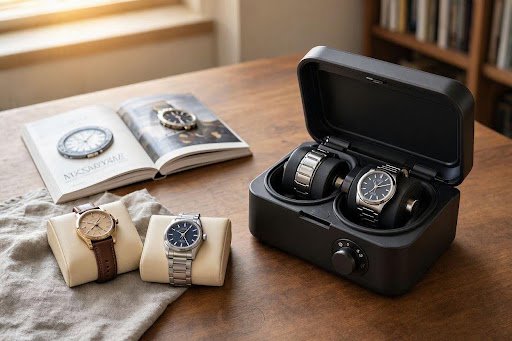
If you own an automatic watch, you’ve probably asked yourself this question at some point: does it actually need a winder, or is that just something retailers say to sell more accessories?
The honest answer is that it depends on your watch, how often you wear it, and how much you value convenience. Automatic watches run on movement, not batteries. Wear one every day and the natural motion of your wrist keeps it powered. Leave it in a drawer for a week and it stops. That’s not a fault. It’s simply how mechanical movements work.
This guide walks through what a watch winder actually does, when you genuinely need one, and how to pick the right one for your collection.
What a Watch Winder Actually Does
A watch winder is a small motorised box that rotates a watch continuously, mimicking the movement of your wrist. The rotor inside an automatic movement responds to that motion by winding the mainspring, keeping the watch powered and ready to wear.
This matters most for two situations: watches with complications that are a hassle to reset, and watches you don’t wear every single day.
A simple three-hand automatic is easy to set. Pull the crown, adjust the time, done. But a watch with a perpetual calendar, moon phase, or GMT function can take real effort to reset correctly after it stops. Some perpetual calendars require you to correct the date, day, month, and moon phase in a specific sequence, and doing that wrong can strain delicate components. A winder removes that hassle entirely by keeping the watch running even when it’s not on your wrist.
Do You Actually Need One?
Not every automatic watch owner needs a winder. Here’s a practical way to think about it.
You’ll benefit from a winder if:
- You own more than one automatic watch and rotate between them
- Your watch has a complicated calendar or moon phase function
- You travel often and don’t wear the same watch every day
- You want your watch ready to wear at a moment’s notice, with the correct time and date already set
You probably don’t need one if:
- You wear the same automatic watch daily
- Your watch is simple to reset (time and date only)
- You don’t mind manually winding or resetting occasionally
There’s no rule that says every automatic watch owner must own a winder. It’s a convenience tool, and for some watches and lifestyles, that convenience is genuinely worth it.
Signs Your Watch Needs a Winder
A few practical signs point to a winder being a good investment rather than a nice-to-have:
- Your watch keeps stopping between wears. If you find yourself resetting the time every few days, a winder solves that immediately.
- You have a growing collection. Once you own three or more automatic watches, keeping each one powered manually becomes genuinely tedious.
- You own a watch with a complex calendar. Annual calendars, perpetual calendars, and moon phase watches are the clearest case for a winder, since correcting them by hand is time-consuming and, on older or delicate movements, can be risky if the crown is turned during restricted correction windows.
- You want consistent lubrication. Keeping a movement gently running helps distribute the internal lubricants evenly, rather than letting the watch sit static for long stretches.
How to Choose the Right Watch Winder
Picking a winder isn’t just about finding one that fits your watch box. Two technical settings matter more than anything else: turns per day (TPD) and rotation direction.
Turns Per Day (TPD)
Every automatic movement has a manufacturer-recommended TPD, usually somewhere between 600 and 960 turns. Too few turns and the watch won’t stay fully wound. Too many, and you’re putting unnecessary wear on the movement over time. A good winder lets you set the TPD to match your specific watch rather than running at a single fixed speed.
Rotation Direction
Movements are built to wind in a specific direction: clockwise, counter-clockwise, or bi-directional. Using the wrong setting won’t damage most modern movements, since many have a bidirectional winding mechanism, but matching the correct direction for your specific caliber is still the more precise approach, and it matters for movements that only wind in one direction.
If you’re not sure what settings your watch needs, the manufacturer’s manual or an official parts list is the most reliable source. Getting this right is one of the more overlooked details when buying a winder, and it’s worth taking a few extra minutes to check before purchasing.
Single vs Multi-Watch Winders
If you own one automatic watch, a single winder is all you need. Collectors with several pieces tend to move toward multi-watch winders, which power more than one watch at a time and often let you set different TPD and direction values for each slot. This is especially useful if your collection spans different brands and movement types, since a Rolex, a Panerai, and an Omega can all have different winding requirements.
For those specifically building an Omega collection, the winding requirements can vary noticeably between calibers, and it’s worth reading through best watch winders for explained for a caliber-by-caliber breakdown before choosing a winder.
Materials and Build Quality
Not all winders are built the same. A few things separate a well-made winder from a cheap one:
- Motor quality: Look for Japanese-made or German-made motors, known for running quietly and consistently over years of use.
- Interior lining: A soft, non-abrasive lining protects the watch case and strap from scuffing during rotation.
- Cushion/pillow fit: The watch pillow should hold your specific case size securely without excessive movement.
- Power options: Battery-only winders are portable but need regular battery changes. Mains-powered options run continuously without maintenance.
Spending a bit more upfront on a winder with a reliable motor and proper cushioning tends to pay off, since the alternative is a device running 24/7 for years with a cheap motor sitting right next to your watch.
Where to Find a Reliable Winder
If you’re shopping for a winder, it’s worth going through a specialist retailer rather than a generic electronics seller, since fit, motor quality, and TPD accuracy vary a lot between brands. The Aevitas UK store stocks a range of single and multi-watch winders built for different collection sizes, and you can see more here if you want to compare options by capacity, finish, and price point.
Caring for Your Automatic Watch Beyond a Winder
A winder helps with power reserve, but it’s only one part of looking after an automatic watch properly.
- Service intervals: Most manufacturers recommend a full service every four to seven years, regardless of how the watch is stored.
- Water resistance checks: Gaskets degrade over time even if the watch isn’t submerged often. Have water resistance checked annually if you swim or dive with your watch.
- Storage away from magnets: Phones, laptop speakers, and some bag clasps contain magnets strong enough to affect timekeeping accuracy. Keep watches, wound or not, away from these where possible.
- Avoid extreme temperatures: Leaving a watch in direct sunlight or a hot car can affect the lubricants inside the movement over time.
For a deeper look at how mechanical movements work and how lubrication and servicing affect long-term accuracy, the British Horological Institute publishes useful, independent guidance for watch owners who want to understand the mechanics behind their collection.
Final Thoughts
A watch winder isn’t a requirement for every automatic watch owner, but it solves a real problem for anyone with more than one piece, a complicated calendar function, or a habit of rotating watches throughout the week. The right winder, set to the correct TPD and direction for your specific movement, keeps your watch accurate, wound, and ready to wear without the hassle of resetting it every time you pick it up.
If you’re building out a collection or just tired of resetting the same watch every few days, it’s a small investment that pays off in convenience almost immediately.
FAQs
Do watch winders damage automatic watches? No, a well-made winder set to the correct TPD and direction for your movement won’t cause damage. Problems only tend to arise with cheap winders that run at a fixed, incorrect speed for extended periods.
How long should I run my watch on a winder? Most winders can run continuously without issue. Some owners prefer to run the winder for a few hours a day rather than 24/7, but continuous operation on a quality winder is generally safe for the movement.
Can I use one winder for different watch brands? Yes, as long as you can adjust the TPD and rotation direction for each watch. Multi-watch winders with individual settings per slot are ideal for mixed collections.
Is a watch winder worth it for just one watch? If you wear that watch daily, probably not. If it has a complicated calendar or you don’t wear it every day, a single winder can still be worthwhile.
What TPD setting should I use if I don’t know my watch’s exact requirement? Check the manufacturer’s manual first. If that’s not available, a mid-range setting of around 800 TPD with a bidirectional rotation is a reasonably safe starting point for most modern automatic movements.
