


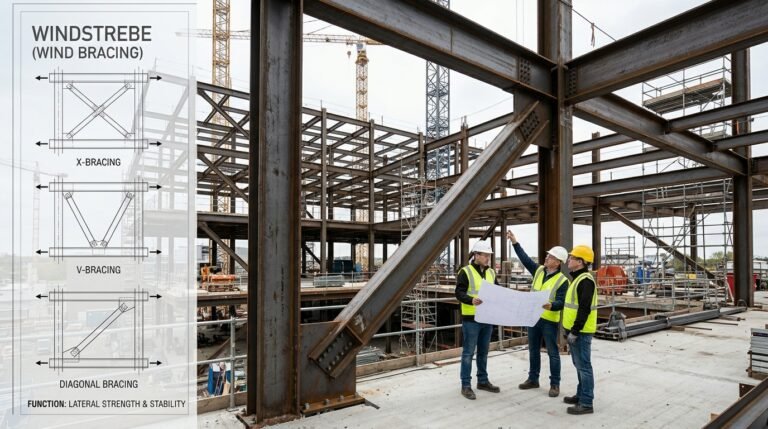
Windstrebe is a German construction term generally translated as wind brace. It describes a diagonal structural member or bracing component that helps improve stability and resist sideways movement caused by external forces. In timber roof construction, the term can refer more specifically to an inclined member connecting neighbouring rafters to provide longitudinal bracing.
Windstreben are relevant to traditional timber roofs and other structural arrangements where stability depends on properly positioned diagonal supports. Understanding their purpose, materials, and relationship with other bracing components helps explain how buildings resist lateral forces and maintain their structural integrity.
What Does Windstrebe Mean?
The word Windstrebe comes from German construction terminology. It combines Wind, meaning wind, and Strebe, meaning brace or supporting member.
In English, Windstrebe is commonly understood as a wind brace. However, its precise meaning depends on the construction context in which it appears.
In timber roof construction, it can describe an inclined wooden member positioned within the roof plane. This member connects neighbouring rafters and helps prevent unwanted longitudinal movement.
The term is also discussed more broadly in relation to diagonal bracing and structural stability. Therefore, when interpreting architectural drawings, renovation documents, or engineering specifications, it is important to consider the exact component being described.
What Is a Windstrebe in Roof Construction?
In traditional timber roofing, a Windstrebe can be an inclined timber member connecting two neighbouring rafters. Its purpose is to strengthen the roof structure against movement along its length.
A roof consists of several interconnected structural elements, including rafters, ridge components, purlins, and supporting walls. Although these members carry loads, their arrangement must also provide resistance against sideways movement.
A properly designed diagonal brace helps connect structural members and maintain their relative positions. This becomes particularly important when wind acts on a roof and produces horizontal forces.
The exact arrangement depends on the roof design, timber dimensions, connection details, and applicable structural requirements. A Windstrebe should therefore be understood as part of a larger structural arrangement rather than an independent solution to every wind-related problem.
How Does Windstrebe Work?
Windstrebe works through diagonal support. Its inclined position helps transfer forces between connected structural members and reduces unwanted movement.
Imagine a rectangular frame without diagonal support. When a sideways force acts on it, the frame may deform into a parallelogram. This movement is commonly described as racking.
Adding a suitable diagonal brace helps resist that deformation. Depending on its design and connections, the brace can carry tension, compression, or a combination of forces.
In a roof structure, the bracing arrangement helps maintain the alignment of rafters and transfers longitudinal forces toward other supporting components.
The effectiveness of this arrangement depends on more than the brace itself. Connections, supporting members, and the complete load path must all be considered.
Why Is Windstrebe Important for Structural Stability?
Wind forces can produce pressure and suction on different parts of a building. These forces may create sideways movement or additional stresses within the roof and supporting structure.
Windstrebe contributes to structural stability by helping resist unwanted movement and maintaining the intended geometry of connected members.
Its main benefits include:
- Improved stability: Diagonal support helps reduce movement within suitable structural arrangements.
- Resistance to lateral forces: Bracing helps transfer horizontal forces through the building’s structural system.
- Better alignment: Properly positioned members help maintain the relationship between connected rafters or frame elements.
- Reduced deformation: Bracing can help limit racking and unwanted displacement.
- Structural reliability: Correctly designed connections help ensure that forces can travel through the intended load path.
These benefits depend on proper engineering. A brace with inadequate connections or unsuitable dimensions may not provide the required structural performance.
Where Is Windstrebe Used?
The term is particularly relevant to timber roof construction, although wind-bracing principles are used across several types of structures.
Traditional Timber Roofs
Traditional timber roofs use interconnected wooden members to support roof coverings and transfer loads to the building’s supporting structure.
A Windstrebe may connect neighbouring rafters within the roof plane, helping resist longitudinal movement. Its position and dimensions depend on the roof’s design.
Timber-Framed Buildings
Timber-framed buildings use posts, beams, rafters, and other components to form a structural framework. Diagonal bracing can help prevent the frame from deforming under lateral forces.
The specific bracing arrangement must be designed to suit the building’s geometry and loading conditions.
Industrial Buildings
Large industrial buildings often require dedicated bracing systems to manage horizontal forces. These may involve diagonal steel members, tension components, and connections between structural frames.
Although the engineering principle is related, not every industrial diagonal brace should automatically be called a Windstrebe.
Renovation and Restoration Projects
Older buildings may contain traditional timber braces that contribute to the stability of their roof structures.
During restoration, these components should be identified and assessed before repairs or replacements are made. Removing or changing a structural brace without understanding its function can affect the wider roof system.
What Materials Are Used for Windstrebe?
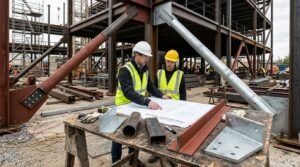
The material depends on the structural application, design requirements, and surrounding construction.
Timber
Timber is commonly associated with traditional roof bracing. Wooden braces can be integrated into timber frames and connected to neighbouring structural members.
The selected timber must be appropriate for the expected forces and environmental conditions. Moisture exposure, decay, splitting, and connection quality should also be considered.
Steel
Steel is used in many modern structural bracing arrangements because it can provide substantial strength with relatively compact components.
Steel braces may take the form of rods, angles, plates, or other engineered members. Their suitability depends on the structural design and connection details.
Metal Bracing Straps
Metal straps are another option in roof-bracing systems. They can help transfer forces between structural members when designed and installed for the intended loading conditions.
A metal strap is not automatically equivalent to a solid timber Windstrebe. Their structural behavior and connection requirements can differ considerably.
Different Types of Wind Bracing
Wind bracing can be arranged in different ways depending on the building’s structural system.
Diagonal Bracing
Diagonal bracing uses an inclined member between connected structural points. It helps resist sideways movement and maintain the shape of a frame.
Cross Bracing
Cross bracing uses two diagonal members that form an X-shaped arrangement. It is frequently used in structural frames where additional resistance to lateral forces is required.
Timber Roof Bracing
Timber roof bracing uses wooden members positioned within the roof structure. Depending on the design, these components may connect rafters or provide stability across the roof plane.
Steel Bracing
Steel bracing uses engineered steel components to transfer forces through structural frames. It is common in industrial and commercial construction.
These are general bracing arrangements rather than a universal classification of Windstrebe. The correct terminology depends on the actual component and its role in the building.
Windstrebe vs. Windrispe vs. Windrispenband vs. Windverband
German construction terminology includes several related words that can be confusing when translated into English. Although they are connected with wind resistance and structural stability, they do not necessarily describe the same component.
| German term | General English meaning | Typical context |
|---|---|---|
| Windstrebe | Wind brace or diagonal bracing member | Roof and structural bracing |
| Windrispe | Related roof-bracing member | Timber roof construction |
| Windrispenband | Wind-bracing strap | Metal roof-bracing arrangements |
| Windverband | Wind-bracing system | Wider structural stability arrangements |
| Strebe | Brace, strut, or supporting member | General structural construction |
The distinction is important when reading German architectural drawings or construction specifications. A Windrispenband, for example, is generally a metal strap, whereas a timber Windstrebe may be a solid inclined member.
The terms should not be used interchangeably without checking the original technical context.
How Is Windstrebe Designed and Connected?
The design of a Windstrebe depends on the forces it must resist and the structural members it connects.
Engineers consider several factors before selecting an appropriate bracing arrangement:
- Wind loads: Expected wind pressure and suction must be considered.
- Structural geometry: Roof dimensions, rafter positions, and overall building configuration influence the arrangement.
- Material properties: Timber and steel have different strength and deformation characteristics.
- Connection details: Bolts, screws, plates, and other fasteners must be suitable for the expected forces.
- Load transfer: The bracing arrangement must connect effectively to the wider structural system.
- Building requirements: Applicable building regulations and engineering standards must be followed.
A brace is only effective when its connections and supporting elements can transfer the forces safely. Selecting a component based on appearance alone is not an appropriate substitute for structural design.
Common Bracing Problems and Inspection
Over time, structural bracing may develop problems due to moisture, material deterioration, movement, or inadequate connections.
Common issues include:
- Cracked or split timber.
- Rot caused by prolonged moisture exposure.
- Corrosion in metal components.
- Loose or damaged fasteners.
- Displacement of connected structural members.
- Poorly executed alterations or repairs.
Regular inspection can help identify visible damage before it becomes more serious. However, a visual inspection cannot establish the complete load-bearing capacity of a structural member.
If a brace appears damaged or disconnected, a qualified building professional or structural engineer should assess the structure and recommend suitable repairs.
Can a Windstrebe Be Removed?
A Windstrebe should never be removed simply because it appears unnecessary or obstructs another part of a renovation project.
It may contribute to the stability of the roof or transfer forces between structural members. Removing it without an appropriate assessment could increase movement, weaken the bracing arrangement, or affect other parts of the building.
Before changing an existing brace, a structural engineer should identify its function, examine the surrounding connections, and determine whether an alternative structural solution is required.
This is especially important in older timber buildings, where traditional structural arrangements may not be obvious from their external appearance.
Is Windstrebe Still Relevant in Modern Construction?
Yes. The principles behind Windstrebe and diagonal bracing remain relevant in modern construction.
Contemporary buildings use a variety of materials and engineered systems, but they still need to resist horizontal forces and maintain structural stability.
Modern timber construction may use engineered timber products, metal straps, and purpose-designed connectors. Steel buildings may use diagonal members and complete bracing systems to transfer lateral loads toward their foundations.
The specific products and methods have evolved, but the underlying engineering requirement remains the same: structural components must work together to resist the forces acting on the building.
Frequently Asked Questions
1. What does Windstrebe mean in English?
Windstrebe is a German construction term generally translated as wind brace. In timber roof construction, it can refer to an inclined member that connects neighbouring rafters to provide longitudinal bracing.
2. What is the main purpose of a Windstrebe?
Its purpose is to help improve structural stability by resisting unwanted movement and transferring forces between connected structural members.
3. Is Windstrebe the same as Windrispenband?
No. Windstrebe can refer to a diagonal bracing member, while Windrispenband generally refers to a metal wind-bracing strap. Their structural applications and connection requirements can differ.
4. Which materials are used for Windstrebe?
Timber is associated with traditional roof bracing, while steel and metal components are used in various modern bracing arrangements. The appropriate material depends on the structural design.
5. Can a Windstrebe be removed from a roof?
It should not be removed without professional assessment. A Windstrebe may contribute to the stability of the roof, and changing it without an engineered solution could compromise the structure.
Conclusion
Windstrebe is an important German construction term associated with wind bracing and structural stability. In timber roof construction, it can describe an inclined member connecting neighbouring rafters to help resist longitudinal movement. Its effectiveness depends on suitable materials, correct positioning, reliable connections, and integration with the wider structural system. Understanding the difference between Windstrebe and related terms such as Windrispe, Windrispenband, and Windverband makes construction documents easier to interpret and helps prevent confusion during building, inspection, and renovation projects.
Related Post
Mangadistrict: Features, Manhwa Library, Genres, and Safety Guide!
Comisaco: Company Overview, History, Ownership, and Irrigation Operations!
