



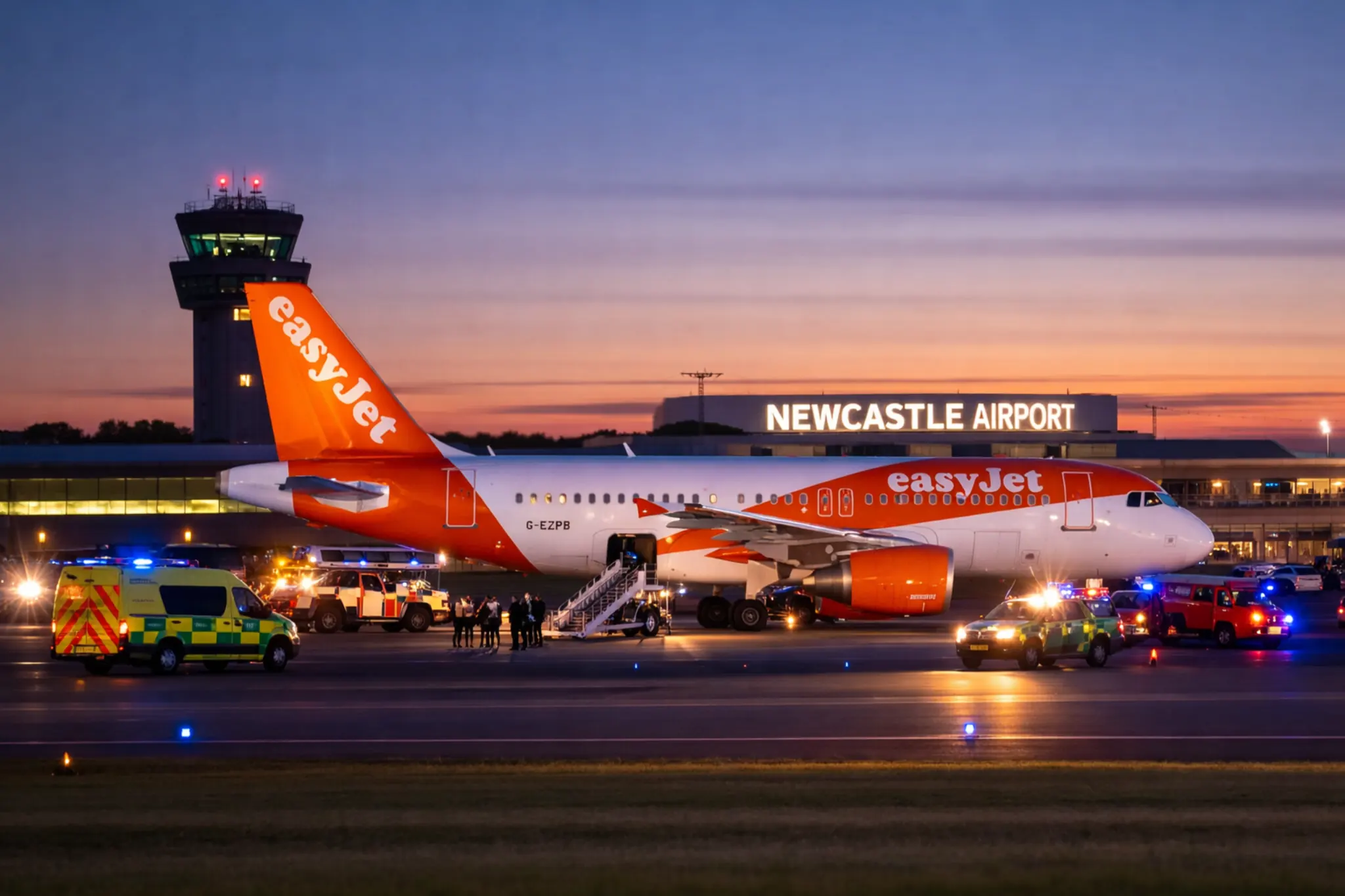
Seeing “emergency landing” in a headline can feel scary, especially if you or someone you know was traveling that day. But in commercial aviation, an emergency diversion is often a calm, safety-first decision—made to get help sooner, reduce risk, and land at an airport that can handle the situation quickly. The phrase EasyJet Flight U2238 Emergency Landing Newcastle refers to a flight that was heading to Manchester but diverted and landed at Newcastle instead after an urgent issue onboard.
Diversions like this are not rare events in global air travel, and they usually show the system working as designed: identify a problem, prioritize safety, and get support on the ground. Below is a clear, step-by-step explanation of what was reported, what the key terms mean, why Newcastle made sense, and what passengers typically experience when a flight diverts.
What Happened on EasyJet Flight U2238?
EasyJet Flight U2238 was operating a scheduled route from Copenhagen to Manchester when it diverted to Newcastle Airport. Online flight tracking and aviation reporting described the aircraft as declaring an emergency and then landing safely in Newcastle. The core timeline is straightforward: the crew identified an urgent situation, worked with air traffic control to change course, and landed at a nearby suitable airport rather than continuing to Manchester right away.
For passengers, this can feel sudden—one moment you expect your usual arrival, and the next you are descending toward a different city—but diversions are planned for in airline operations and are handled with clear checklists and coordination.
The Reported Cause: Passenger Welfare and Medical Urgency
Public descriptions of the incident pointed to a passenger welfare or medical issue onboard. That wording is common because airlines and crews avoid sharing personal health details, and because the priority is care, not publicity. Medical events in flight can range from fainting and breathing difficulties to severe symptoms that require urgent evaluation.
When time could matter, crews may decide that landing sooner is the safest option, especially if the best care is on the ground rather than in the air. The decision is rarely made on a guess; it typically comes from cabin observations, any help offered by medical professionals onboard, and a practical assessment of how quickly the passenger can reach proper treatment if the aircraft lands at the closest suitable airport.
U2238 vs U2 2238 vs EZY2238: Why the Same Flight Looks Different Online
Many readers notice different versions of the flight number across apps, screenshots, and posts. easyJet uses “U2” as its airline code in schedules and tickets, while some operational systems and trackers display “EZY.” That is why you may see U2238, U2 2238, or EZY2238 referring to the same service. Another reason for confusion is spacing: some places show the airline code and the flight number together with no gap, while others split them. For your article, it helps to mention this once, early, so readers can match what they saw online with the flight you are explaining—and so the discussion stays focused on the incident rather than the formatting.
Quick Facts at a Glance
-
Route: Copenhagen to Manchester
-
Diversion airport: Newcastle (NCL)
-
What was reported: An urgent passenger welfare / medical situation
-
Result: Safe landing and ground assistance
Why Newcastle Was a Logical Diversion Point
When a flight needs to land earlier than planned, the best airport is the one that can safely accept the aircraft quickly and support what happens next. Crews and controllers weigh factors like distance, weather, runway length, available emergency response, and how smoothly the landing and arrival can be managed. Newcastle is a major airport in northeast England that can handle commercial jets and coordinate assistance on the ground, which makes it a practical choice when a flight approaching the region needs to get down without delay. A diversion airport also needs the ability to handle passengers comfortably and safely, even if the stop turns into a longer delay, and larger regional airports are often better prepared for that than smaller airfields.
What “Declaring an Emergency” Means and Why Squawk 7700 May Appear
In aviation, declaring an emergency is not a public drama signal—it is a safety tool. It tells air traffic control that the flight needs priority handling, such as direct routing, fewer delays in the approach, and faster coordination with airport services. Some flights also use the general emergency transponder code (often called 7700), which helps controllers and systems identify the aircraft as needing priority support. Importantly, an emergency declaration can happen for many reasons, including medical situations, and it does not automatically mean the aircraft itself is failing. For people watching online, a 7700 code can look alarming, but in practice it often means the crew is doing exactly what they should do: communicate clearly and ask for help early.
What Happens in the Cabin During a Medical Diversion
Cabin crew are trained for in-flight medical response and first aid, and they work in a tight space with limited equipment compared to a hospital. When a passenger becomes seriously unwell, crew typically assess the person, use onboard supplies, and look for medical professionals who can help. They also share key information with the cockpit so the captain can make decisions about speed, altitude, and whether to divert.
On many airlines, the crew may also consult a ground-based medical support service so the diversion choice is informed by both medical urgency and operational realities. Even small details can matter, such as whether the passenger can sit upright, whether symptoms are improving, and whether oxygen support is needed, because those details can change how urgent it is to land.
What Happens After Landing at Newcastle
After landing, the goal is to transfer the situation from “in the air” to “supported on the ground.” That may involve medical staff meeting the aircraft, assessing the passenger, and arranging further care if needed. At the same time, the airline must manage the practical side for everyone else onboard: coordinating gates, updating departure plans, checking crew duty limits, and deciding whether the flight can continue to Manchester or if passengers must be rebooked.
Even with a safe landing, the hours after a diversion can include delays and uncertainty, so clear announcements and calm instructions become very important. Diversions can also temporarily affect airport flow—other aircraft may be asked to wait or change sequencing—because priority handling is part of responding to an emergency.
Was This a Technical Emergency or a Passenger Emergency?
A big question people ask is whether the aircraft had a mechanical problem. Based on the way the incident was described publicly, the emphasis was on a passenger welfare or medical issue rather than a confirmed technical fault. That matters because “emergency landing” can mean anything from a precautionary landing to a time-critical medical diversion. Without an official technical statement, the most accurate approach is to avoid guessing and stick to what was consistently described: a diversion linked to an onboard passenger-related emergency.
If you want to add context, you can explain that airlines treat both categories seriously—technical and medical—but the public language used after a medical diversion is often simpler and more privacy-focused.
What Passengers Should Do If Their Flight Is Diverted
If you ever find yourself on a diverted flight, the best approach is practical and calm. First, follow crew instructions—those directions are designed to keep the cabin safe and help the crew work efficiently. Next, keep your boarding pass, take screenshots of any updates, and save receipts for reasonable expenses if you are stuck for a long time. If the diversion leads to a major delay, overnight disruption, or cancellation, ask the airline staff what your options are for rebooking, refunds, and care during the wait.
In the UK and Europe, disruption rules often involve two ideas: the airline should help with basic care during long waits, and compensation may depend on the cause and how long the delay becomes. Even when compensation is not available, asking early about rebooking choices can save hours.
How to Verify Details Without Spreading Rumors
Emergency diversions spread fast online, and early details can be wrong or incomplete. The most reliable public information is usually the basic “who, where, and what”: origin, intended destination, diversion airport, and confirmation of a safe landing. Flight trackers can show the path change and arrival airport, but they rarely explain the medical or operational reason in a confirmed way.
If you are writing about the incident, keep your language careful: focus on verified route facts and use general phrasing like “reported as a medical or passenger welfare issue” rather than repeating unconfirmed claims. It also helps to avoid quoting random posts as fact; a calm summary built on consistent details reads more trustworthy and is more useful for readers who simply want to understand what happened.
Why This Incident Matters to Travelers
The EasyJet Flight U2238 Emergency Landing Newcastle story matters because it shows how aviation handles urgent situations in real life. Diversions can be inconvenient, but they exist to protect people. Crews train for medical events, air traffic control can prioritize a flight that needs assistance, and airports have processes to support arrivals that were not planned.
For travelers, the most reassuring takeaway is that an “emergency landing” often means the system is doing what it is supposed to do: reduce risk and get help quickly. It also highlights a practical truth of travel: sometimes the safest plan is to change the plan, and that can mean arriving later, arriving in a different city first, or waiting while the airline resets the schedule.
Conclusion
The headline EasyJet Flight U2238 Emergency Landing Newcastle can sound dramatic, but the most important facts are simple: the flight was traveling from Copenhagen to Manchester, an urgent onboard situation led to a diversion, and the aircraft landed safely at Newcastle so the issue could be handled on the ground. Public descriptions centered on passenger welfare and medical urgency, which is a common reason for time-sensitive diversions.
For readers and travelers, this incident is a reminder that diversions are not a sign of panic—they are part of a structured safety process built to bring everyone down safely. If you are ever involved in a diversion, staying calm, saving key documents, and asking the airline about options after the situation is stable are the most helpful steps.
Frequently Asked Questions (FAQs)
What is EasyJet Flight U2238?
It is an easyJet flight identifier used in schedules and online discussion, and it may also appear in trackers in slightly different formats.
Why did EasyJet Flight U2238 land in Newcastle?
Reports described an urgent passenger welfare or medical situation, so the crew diverted to land sooner and get ground support.
Did the plane land safely at Newcastle?
Yes. Public reporting described a safe landing after the diversion.
Was the emergency caused by a mechanical failure?
Available descriptions focused on a passenger-related emergency rather than a confirmed aircraft technical fault.
What does it mean when a flight “declares an emergency”?
It means the crew requested priority handling from air traffic control due to an urgent situation.
What is squawk 7700?
It is a standard transponder code that can indicate a general emergency so controllers can prioritize the aircraft.
Can a medical issue really cause an emergency diversion?
Yes. If time is critical, landing sooner can be the safest way to get proper medical care.
Why would Newcastle be chosen instead of Manchester?
Diversion airports are selected for practicality—distance, suitability, and the ability to support what happens next.
Do passengers have to stay on the aircraft during a diversion?
Sometimes. It depends on the situation, airport procedures, and what the airline needs to do next.
Will a diverted flight always continue to its destination?
Not always. Some continue later, while others may be delayed longer, rescheduled, or canceled.
What should passengers save for claims or follow-ups?
Keep boarding passes, receipts for reasonable expenses, and screenshots of delay updates if disruption becomes significant.
Are flight tracker details always accurate?
They are helpful for routes and times, but they may not reliably explain the reason for a diversion.
FOR MORE : INSIDE FAME
