



When people first heard about easyjet u22152 emergency germany, many imagined the worst: a serious failure, chaos in the cabin, or a major accident. In reality, what happened on this flight is a textbook example of how modern aviation handles sudden problems safely. An ordinary journey from Istanbul to Manchester turned into an unscheduled stop in Germany after a member of the cockpit crew became unwell.
The aircraft diverted, landed safely, and passengers later continued their trip, shaken but protected by well-trained professionals and robust procedures. This full overview walks through the route, the incident, and what it all means for travelers in the US, UK, and around the world.
The role of U22152 on the Istanbul–Manchester route
Flight U22152 is part of easyJet’s regular service connecting Turkey and the United Kingdom. On normal days, the Airbus A320 series aircraft assigned to this route flies non-stop from Istanbul Airport to Manchester Airport, covering roughly 1,650 miles in about four to four and a half hours. The service was introduced as part of easyJet’s wider expansion linking Türkiye with northern European hubs, giving travelers a direct option between Istanbul and northwest England.
Typical schedules show several weekly departures, with slight time variations across seasons but a consistent pattern: mid-afternoon departures from Istanbul and early evening arrivals in Manchester.
What happened on 15 August 2025
On 15 August 2025, U22152 departed Istanbul with 185 people on board, bound for Manchester as usual. The aircraft, an Airbus A320-200 registered G-EZRX, climbed to its cruise level of around 36,000 feet over Europe. For much of the journey, everything appeared standard: smooth flight, typical cruise altitude, and a planned arrival in the UK later that day.
The situation changed when the crew encountered a sudden medical problem in the cockpit while the aircraft was roughly 150 nautical miles east-southeast of the German city of Cologne. At that point, the captain faced a critical but well-defined decision: continue toward the UK, or divert to the nearest suitable airport.
The cockpit medical emergency
During the cruise phase over central Europe, the first officer began suffering severe stomach pain and became unable to perform normal duties. In commercial aviation, any loss of capacity by a pilot is treated very seriously. Even though the captain remained fully capable of flying the aircraft alone, the crew’s training and airline rules dictated that this was now a medical emergency. With one pilot effectively incapacitated, the safest option was not to press on toward Manchester but to land as soon as reasonably possible. The captain informed air traffic control that the first officer was unwell and requested an immediate diversion to a nearby major airport in Germany, where medical teams would be ready to assist.
Diversion to Cologne, Germany
The closest suitable facility was Cologne Bonn Airport, a large international airport with long runways and full emergency services in western Germany. Air traffic controllers gave U22152 priority handling, clearing the aircraft to descend from its cruising altitude toward Cologne. Within about 27 minutes of the diversion decision, the Airbus A320 landed safely on runway 32R. Emergency vehicles positioned themselves nearby as a precaution, which is standard practice whenever a flight declares an urgent situation. T
here was no accident, no runway overrun, and no reported injuries from the landing itself. From the outside, the event looked dramatic, but operationally it followed well-rehearsed procedures that exist specifically to keep everyone safe.
What “pilot incapacitation” really means
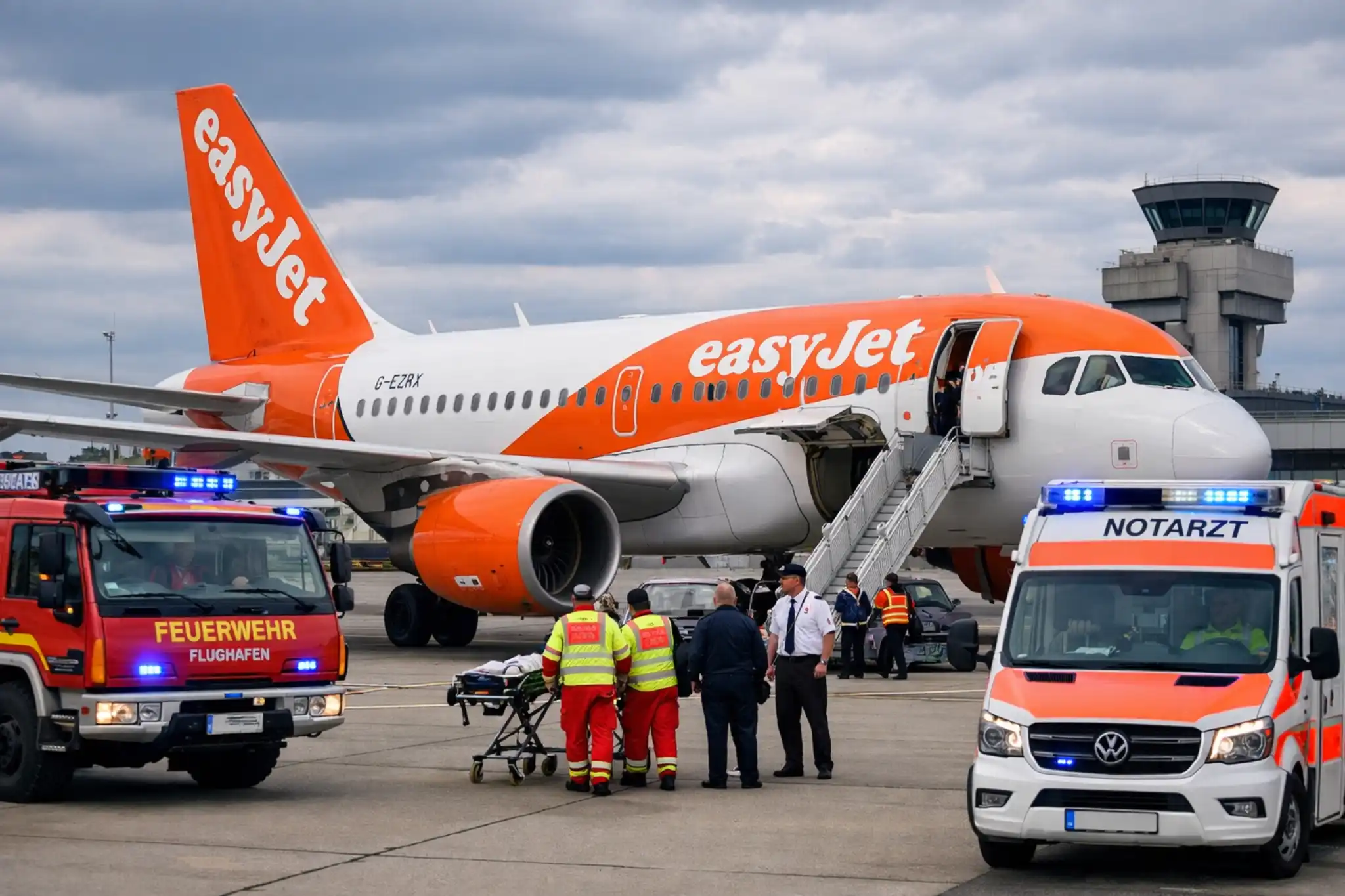
In aviation, the term “pilot incapacitation” covers any situation where a flight crew member can no longer perform their duties properly, whether due to sudden illness, fainting, severe pain, or another medical problem. Regulations assume that such events can happen, which is why commercial flights use at least two pilots on the flight deck. In this case, the captain remained fully fit and continued to fly the aircraft, but the loss of the first officer still triggered a higher level of caution.
Diverting to Cologne allowed medical professionals to attend to the sick pilot quickly and minimized the time the aircraft had to operate with only one active pilot. It is a safety-first mindset: act early, reduce risk, and treat health issues as urgent.
What passengers likely experienced on board
From a passenger’s perspective, the easyjet u22152 emergency germany would have felt sudden but controlled. Cabin crew would have paused normal service, secured the cabin, and prepared everyone for an earlier-than-expected landing. Travelers might have sensed a change in engine noise as the aircraft began descending and turning off its original route.
An announcement from the captain would typically explain that there was a medical issue involving a crew member and that the flight needed to land in Germany so doctors could help. While any unscheduled landing can be worrying, the overall atmosphere usually remains calm because crew members are specifically trained to manage both the technical and emotional side of these events.
A clear timeline of the diversion
To understand the sequence more clearly, it helps to look at the core moments of the diversion in simple order:
-
U22152 departs Istanbul for Manchester with 185 people on board.
-
During cruise at 36,000 feet, the first officer becomes seriously unwell.
-
The captain reports pilot incapacitation to air traffic control and requests a diversion.
-
Controllers route the aircraft to Cologne Bonn Airport in western Germany.
-
About 27 minutes later, the Airbus lands safely on runway 32R, where medical teams are waiting.
After landing: medical help and a replacement pilot
Once on the ground in Cologne, medical teams boarded to assist the first officer, who was taken to hospital with suspected food poisoning. Passengers stayed on board the aircraft while the airline arranged for a replacement pilot to reach Cologne and take over. This process takes time, especially when a new pilot must travel from another base or city.
According to reports, the delay before continuing to Manchester was around five hours, which is long but not unusual for such a situation. The priority remained clear: stabilizing the unwell crew member, ensuring the airplane was in proper condition, and only then allowing the journey to continue on to the UK.
Why Germany is a frequent diversion option
Germany sits at the heart of European air traffic, with major airports at Frankfurt, Munich, Cologne, and other cities handling large numbers of international flights every day. For an aircraft crossing central Europe, these airports are natural diversion points because they offer long runways, advanced medical services, and experienced emergency response teams.
When U22152 needed to land quickly, Cologne made sense both geographically and operationally. For passengers in the US and UK who may be less familiar with European geography, it is worth noting that a diversion to Germany in such a situation is not unusual, but rather a sign that the crew used the best available option at the time.
How this incident fits into the wider safety picture
The easyjet u22152 emergency germany did not involve damage to the aircraft, fire, or a crash. Instead, it joined a long list of flights that diverted for medical reasons and landed safely. In recent years, there have been other high-profile cases where easyJet flights changed course due to serious conditions, such as a tragic case in which a passenger suffered a suspected cardiac arrest and the aircraft diverted so paramedics could meet it on the ground.
These events show that airlines and crews will repeatedly interrupt schedules, accept delays, and take costly detours when someone’s health is at risk. From a safety standpoint, that readiness to divert is a positive sign, not a negative one.
What travelers can learn from easyjet u22152 emergency germany
For travelers, especially those who are nervous flyers, this incident holds some important lessons. First, an emergency landing or diversion does not automatically mean the flight was close to disaster. In most cases, it means the safety systems and procedures worked as intended. Second, airlines and crews are prepared for unexpected health problems, whether they affect a passenger or a crew member.
The cockpit and cabin teams have clear steps to follow, from contacting air traffic control to coordinating with medical staff on the ground. Finally, passengers can contribute to safety by staying seated when asked, fastening seat belts, listening carefully to announcements, and remaining calm even when plans change quickly.
Why this story matters beyond one flight
The story of U22152 is not just about one Airbus making an unscheduled stop in Germany. It speaks to a broader reality in modern air travel: aviation safety is built on layers of preparation, redundancy, and conservative decision-making. Twin-pilot operations are designed so that one pilot can fly while the other is unavailable, but the system still encourages crews to seek the nearest safe landing if anything seems seriously wrong.
For people in the US, UK, and worldwide who travel frequently, these details may never be visible from row 18 or row 25, yet they are quietly working behind the scenes on every trip. When something unusual happens, as it did here, those hidden systems step forward and become very visible.
Final Thoughts
Looking back at the easyjet u22152 emergency germany, the most important fact is simple: the flight landed safely, the unwell first officer received medical attention, and passengers eventually reached Manchester. The diversion to Cologne was inconvenient and worrying for those on board, but it demonstrated exactly how commercial aviation is meant to respond when a crew member can no longer perform their duties.
Instead of pushing on and hoping for the best, the captain chose the cautious route, supported by air traffic control and ground teams in Germany. For anyone reading about this incident from the US, the UK, or anywhere else in the world, the key takeaway is reassuring rather than frightening: when things go wrong in the sky, a whole network of trained professionals and tested procedures is ready to bring everyone back down safely.
Frequently Asked Questions (FAQs)
What route does easyJet flight U22152 normally fly?
U22152 is a regular international service linking Istanbul Airport in Turkey with Manchester Airport in the United Kingdom, typically operating several times per week on an Airbus A320 family aircraft.
What exactly happened during the easyjet u22152 emergency germany incident?
During a flight on 15 August 2025, the first officer became seriously unwell while the aircraft was cruising over Europe, so the captain diverted the flight to Cologne Bonn Airport in Germany for a safe landing and medical help.
Was anyone injured on flight U22152 because of the diversion?
There were no reports of injuries caused by the flight operations themselves; the concern centered on the first officer’s sudden illness, which required hospital treatment but did not lead to a crash or impact-related harm.
Why did the pilots choose Cologne instead of continuing to Manchester?
Cologne was a nearby major airport with suitable runways and full emergency services, so landing there quickly reduced the time the flight had to operate with one active pilot and allowed doctors to reach the first officer without delay.
What is pilot incapacitation in commercial flying?
Pilot incapacitation is when a pilot can no longer safely perform their duties due to illness, pain, or another medical issue, and airlines have clear rules requiring crews to treat it as an urgent situation, often including a diversion.
How often do cockpit medical emergencies like this occur?
Such events are uncommon but expected in planning terms, which is why airlines always staff commercial flights with at least two pilots and train them to handle sudden health problems in a structured, safety-first way.
What would passengers have noticed during the emergency?
Most passengers would have felt the aircraft turning and descending earlier than planned, seen cabin crew securing the cabin, and heard announcements explaining that a medical issue meant the flight had to land in Germany ahead of schedule.
How long were passengers delayed because of the diversion?
Reports indicate that passengers faced a delay of about five hours while a replacement pilot was brought in and all checks were completed before the aircraft could continue on to Manchester.
Does an incident like this mean the aircraft itself was unsafe?
No, current information points to a medical problem with a crew member rather than a structural or mechanical fault with the aircraft, so the event does not by itself suggest that the airplane was unsafe to fly.
Is it still safe to fly with the same airline after such an event?
Yes, in fact, the decision to divert and prioritize health and safety shows that the airline and crew followed established procedures, which is exactly what passengers should want to see when something unexpected happens on board.
What should I do as a passenger if my flight diverts for a medical issue?
The best steps are to stay seated with your belt fastened, follow cabin crew instructions, remain calm, and wait for updates, as the crew and ground teams will be working together to resolve the situation as quickly and safely as possible.
How can travelers stay informed after a diversion like easyjet u22152 emergency germany?
After landing, travelers should listen for gate announcements, check the airline’s app or airport screens for updated departure times, and be prepared for some waiting while crews, aircraft, and schedules are rearranged.
FOR MORE : INSIDE FAME
