


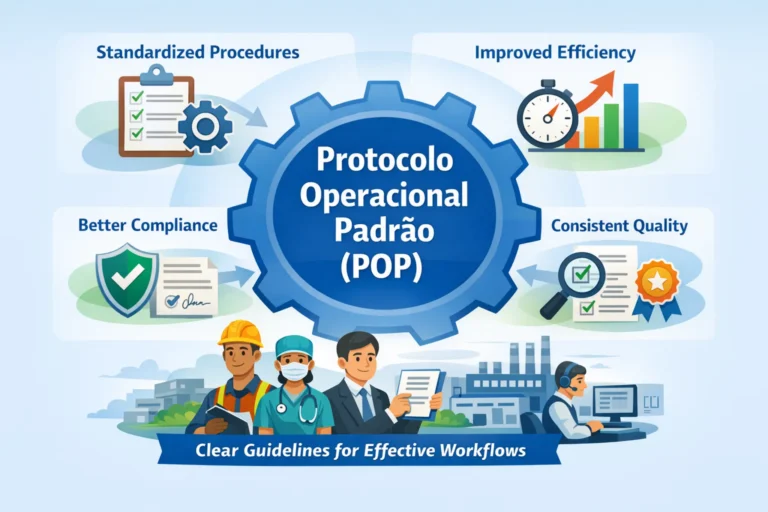
Every organization depends on routines: opening a store, checking equipment, serving a client, closing a financial report. When these activities are carried out in different ways by different people, results become unpredictable. That is where the idea of Protocolo Operacional Padrão (POP) comes in. A POP is the formal, written way to say, “This is how we do things here,” turning daily work into clear, repeatable steps. For companies that want consistent quality, safer operations, and teams that can work smoothly even when people change, understanding POP is no longer optional – it is a basic management tool.
What Is Protocolo Operacional Padrão (POP)?
In simple terms, a Protocolo Operacional Padrão is a document that describes, in detail, how a specific task or process must be executed from start to finish. It usually explains who is responsible, what materials are needed, which tools or systems are used, and what criteria define that the activity was done correctly. In English, it is very close to a standard operating procedure, but the logic is the same in any language: remove guesswork from important activities and replace it with clear guidance that anyone trained in the role can follow.
A good POP does not exist only to satisfy internal rules or external audits. It becomes part of the organization’s memory. Instead of relying on the most experienced employee to “know everything,” the knowledge is captured in a document that survives vacations, turnover, and growth. When new people arrive, they have a step-by-step reference. When leaders need to improve something, they can look at the protocol, identify gaps, and update it. Over time, the POP becomes a living guide that evolves together with the business and supports continuous improvement.
Why POP Matters in Modern Organizations
Modern businesses operate in environments that are fast, competitive, and heavily regulated. Clients expect the same level of service or quality every time they interact with a brand, and regulators want proof that organizations control risk. A well-structured POP helps deliver this consistency because it makes processes visible and traceable. If a deviation occurs, managers can see exactly which step failed and correct it instead of guessing, which shortens investigations, supports root-cause analysis, and prevents the same error from happening again.
Another important effect of POP is the way it improves communication between areas. When teams agree on a documented standard, the classic blame game between departments starts to lose strength. Everyone can see which step belongs to whom and where handoffs happen. This clarity reduces rework, avoids duplicated effort, and gives employees more confidence, because they know what is expected and what “good work” looks like in concrete terms. Well-designed protocols also support training and onboarding, since they offer a single source of truth instead of informal instructions that change from person to person.
Key Components of a POP
Even though each organization has its own culture and vocabulary, robust POPs tend to share a common core. At minimum, they explain the purpose of the activity, the scope – where and when it applies – and the sequence of actions that must be followed. Many also describe safety precautions, required documents, and measurable results, such as acceptable ranges or tolerances. When these elements are written in plain, direct language, the protocol can be understood not only by experts but also by new employees and temporary staff who need to apply it correctly from day one.
To make this easier, many companies design each POP around a simple set of sections, for example:
-
Title or code that identifies the protocol
-
Objective and scope of the process
-
Roles and responsibilities involved
-
Detailed sequence of activities
-
Controls, records, and acceptance criteria
This type of structure keeps documents consistent across different areas, which helps when training, auditing, or reviewing them later. Workers quickly learn where to look for information, and managers can compare protocols side by side when seeking opportunities to simplify or harmonize processes.
How POP Streamlines Workflows
The most visible benefit of POP appears in day-to-day workflows. Imagine a maintenance team that receives daily requests from production. Without a protocol, each technician might prioritize tasks according to personal judgment, leading to frustration and delays. With a POP that defines how requests are logged, prioritized, assigned, and closed, the team can process work in a predictable way. This does not remove the need for expertise, but it keeps the basic flow stable so that specialists can focus on solving problems instead of fighting chaos and searching for missing information.
Something similar happens in customer service, logistics, clinical environments, and even in creative industries. Whenever a process is repeated frequently, a clear protocol helps reduce idle time, waiting, and back-and-forth communication. People know which forms to use, which system fields to fill, and which approvals they must obtain before moving to the next step. Over time, this reduces lead times, lowers error rates, and increases trust between the organization and its clients, because the experience becomes more consistent and less dependent on individual improvisation.
How to Create a POP Step by Step
Creating a POP from zero may seem intimidating, but the work becomes manageable when broken into stages. First, leaders choose a process that truly needs standardization – ideally one that is critical for quality, safety, cost, or customer satisfaction. Next, process owners map the current way of working, observing what people actually do, not only what management believes happens. Once the real flow is clear, a small group representing different roles designs the desired standard, discusses risks and exceptions, and agrees on the best sequence of actions. The protocol is written in a format that suits the organization, tested in practice, adjusted as needed, approved by leadership, and finally communicated with training so that everyone understands both the steps and the reasons behind them.
Common Mistakes to Avoid
Some organizations treat POPs as static documents written only to satisfy external inspections. When this happens, protocols are created once and then forgotten in folders or shared drives, and employees either do not know they exist or see them as obstacles. To avoid this, each protocol should have a clear owner who reviews it regularly, listens to suggestions from the people who use it, and keeps it aligned with real work conditions. It is also important to avoid overly technical language or huge blocks of text, because when instructions are hard to read, workers will naturally rely on memory instead of consulting the document.
POP in Different Industries and Compliance
The principles behind POP are universal, but the focus of each protocol changes according to the sector. In manufacturing and industrial plants, they typically describe machine setups, maintenance routines, cleaning sequences, and inspection points that protect product quality and worker safety. In hospitals and laboratories, POPs guide sample collection, sterilization procedures, patient identification, and emergency response, where a small deviation can have serious clinical consequences. Service sectors also rely heavily on protocols, whether they call them operating manuals, playbooks, or simply routines for handling guests, orders, and financial transactions.
Because POPs specify exactly what should be done and how to document it, they are powerful tools for compliance and risk management. During inspections, organizations can show that they have defined ways of working and proof that these instructions were followed. This traceability makes it easier to reconstruct events, investigate incidents, or demonstrate conformity with laws, technical standards, and internal policies. When teams write protocols, they are naturally forced to ask what could go wrong at each step and to embed double checks, segregation of duties, or safety barriers directly into daily routines, which lowers the chance of accidents and losses.
People, Culture, and the Future of POP
Although POPs are documents, their success depends heavily on people and culture. If employees feel that protocols are imposed without their input, they may obey them only when supervisors are watching or when an audit is near. When frontline workers help create and review POPs, they usually become their biggest defenders, because they see how standards make their day more organized and less stressful. Technology can reinforce this positive relationship: digital platforms allow workers to access the latest version of a protocol on a tablet or phone, complete checklists, attach photos or comments, and send improvement suggestions in seconds.
Over time, the company moves away from improvisation and begins to celebrate teams that prevent problems through clear, shared processes, turning discipline into a natural part of everyday work rather than a burden.
Final Thoughts
A Protocolo Operacional Padrão is not just paperwork; it is the bridge between strategy and execution. By turning important activities into clear, accessible instructions, POPs protect people, strengthen quality, support compliance, and make everyday workflows smoother. They reduce dependence on individual memory and transform knowledge into an asset that belongs to the whole organization, not only to a few experts who have been around for years. For leaders who want to improve performance in a sustainable way, investing time and attention in designing, applying, and updating POPs is a practical starting point.
Beginning with a few critical processes and expanding gradually, any organization – from a small clinic to a global manufacturer or public institution – can use protocols to create more predictable results, healthier teams, and a safer, more organized work environment that keeps improving over time.
Frequently Asked Questions (FAQs)
What is a POP in a company?
In a company, a POP is a formal document that explains exactly how a recurring task or process should be performed, so that different people can produce the same result.
How does a POP improve productivity?
A POP improves productivity by reducing rework, delays, and confusion, since everyone follows the same steps and knows what to do at each stage of the workflow.
Who is responsible for creating a POP?
Usually, the people responsible for a process – such as supervisors, process owners, and quality or safety specialists – work together with frontline employees to design and approve the POP.
How often should POPs be reviewed?
POPs should be reviewed whenever processes, equipment, or regulations change and, even in stable environments, it is wise to review them at least once a year to keep them current.
Do small businesses really need POPs?
Yes. Small businesses may not need extremely complex documents, but simple POPs help new employees learn faster and reduce the risk of errors that can damage reputation or finances.
How is a POP different from a checklist?
A checklist is often one part of a POP. The POP describes the broader purpose, responsibilities, and details, while the checklist is a quick tool to verify that all steps were completed.
Can POPs be used in service industries?
Definitely. Service industries use POPs to standardize how they greet customers, process orders, handle complaints, and deliver consistent experiences, even when demand fluctuates.
What happens if employees do not follow the POP?
If employees do not follow the POP, results become inconsistent and risks increase, so managers should investigate why and either reinforce training or adjust the protocol if it is unclear.
How can I train my team to use POPs?
Training works best when it combines explanation, practical demonstrations, and supervised practice, allowing employees to ask questions and understand the reasons behind each step.
Are POPs useful for onboarding new staff?
Yes, POPs are powerful onboarding tools because they give new staff a concrete guide to daily tasks, reducing anxiety and helping them reach full performance more quickly.
Can POPs support health and safety programs?
They play an essential role in health and safety programs by documenting how to handle hazardous materials, respond to incidents, use personal protective equipment, and report unsafe conditions.
How do I know if a POP is working well?
A POP is working well when the process runs smoothly, error rates and incidents decrease, audit findings are positive, and employees say the instructions are clear and practical to follow.
FOR MORE : INSIDE FAME
