


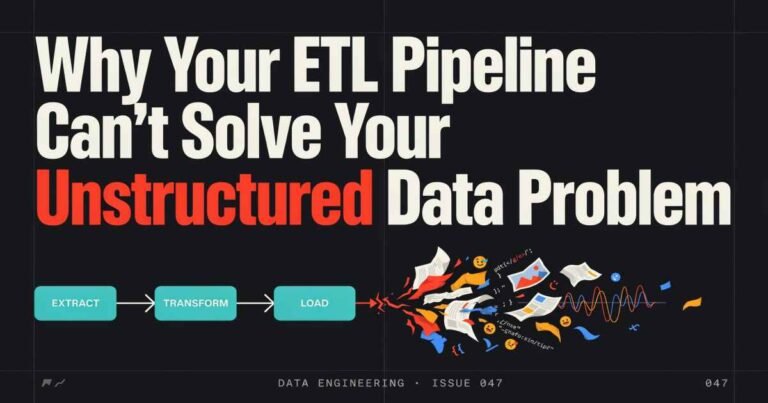
Data engineering teams have spent the last decade building increasingly sophisticated ETL and ELT pipelines – tools that move structured data reliably between databases, warehouses, and applications. Those pipelines are genuinely good at what they do. But ask most data teams how they handle the PDFs, scanned contracts, and unstructured documents flowing into the business, and the answer is often a shrug, a manual workaround, or a separate, half-maintained script that nobody fully trusts.
This isn’t a failure of ETL tooling. It’s a mismatch between what traditional data pipelines were built to do and what unstructured document processing actually requires. This article looks at why that gap exists, why bolting document handling onto a traditional ETL stack tends to disappoint, and what a purpose-built data extraction platform does differently.
What ETL Was Built to Solve
Traditional ETL and ELT tools were designed around a specific assumption: the data has a known, consistent schema. A row in a sales database has predictable columns. A CSV export follows a defined structure. An API response conforms to a documented schema. Given that structure, ETL tools excel at extracting data reliably, transforming it according to defined business rules, and loading it into a destination system – all at scale, with strong guarantees around consistency and reliability.
This model works beautifully for structured data moving between systems that already speak the same structural language. The entire ETL ecosystem – connectors, transformation logic, orchestration, monitoring – is built around that core assumption of known, stable schema.
Where That Assumption Breaks Down
Unstructured documents violate the core assumption ETL tooling depends on. A contract from one vendor looks nothing like a contract from another. An invoice’s layout varies not just between companies but sometimes between different templates from the same vendor. A scanned form might have inconsistent quality, handwritten annotations, or fields in slightly different positions from one submission to the next.
There’s no fixed schema to map against, because the “schema” – if you can call it that – lives in the visual and semantic structure of each document, not in a predictable, consistent format. A traditional ETL connector expects a defined input structure. Unstructured documents don’t offer one.
This is why teams that try to handle document data through their existing ETL stack usually end up building brittle, document-type-specific parsing logic – regex patterns, positional assumptions, custom scripts for each new vendor format – that breaks the moment a document deviates even slightly from what the script was written to expect. It’s not that ETL engineers can’t solve individual parsing problems; it’s that the resulting system requires constant, document-type-by-document-type maintenance that scales poorly as document variety grows.
The Three Capabilities ETL Tools Weren’t Built For
1. Visual and layout understanding. Extracting data from a document often requires understanding where information sits relative to other elements on the page – recognizing that a number in the bottom-right corner near the word “Total” means something different from a similar number elsewhere on the page. Traditional ETL tools have no native concept of visual layout; they operate on structured or semi-structured data formats, not images or page geometry.
2. Semantic field recognition across format variation. A capable extraction system needs to recognize that “Total Due,” “Amount Payable,” and “Balance” might all refer to the same underlying field across different vendor formats – without someone manually mapping every possible label variation in advance. This kind of semantic flexibility isn’t something rule-based ETL transformation logic handles natively; it requires models trained specifically to understand document content contextually.
3. Confidence-aware handling of ambiguity. Structured data pipelines generally assume the data is either present and correct, or missing – a binary state. Document extraction operates in a much greyer zone, where a field might be extracted with high, moderate, or low confidence depending on document quality, layout ambiguity, or unusual formatting. ETL tools aren’t designed around this kind of probabilistic uncertainty; a purpose-built extraction platform is.
Why “Just Add OCR to the Pipeline” Isn’t a Full Solution
A common middle-ground attempt is to bolt a basic OCR step onto an existing ETL pipeline – run documents through an OCR library to get raw text, then feed that text into the existing transformation logic. This solves the character-recognition problem but not the structural one. Raw OCR text output is still just a wall of characters; someone still has to write and maintain the logic that maps specific pieces of that text to the right fields, across every format variation the business encounters.
This approach tends to work reasonably well for a narrow set of highly standardized documents and then degrade quickly as document variety increases – which is exactly the scaling problem most growing businesses run into. It also means data engineering teams end up maintaining two fundamentally different kinds of logic within the same pipeline: reliable, schema-based transformation for structured data, and increasingly fragile, format-specific parsing rules for document data – a combination that gets harder to maintain as both grow in complexity.
What a Purpose-Built Extraction Platform Adds
A dedicated data extraction platform is built around the specific challenges unstructured documents present, rather than treating document handling as an edge case bolted onto structured-data tooling. In practice, that typically means:
Document understanding trained specifically for layout and context, so the system can correctly identify fields based on their visual position and semantic meaning, not just character-level text matching.
Format adaptability without manual template maintenance, so new vendor formats or document layouts don’t require a new parsing script every time – the system generalizes across variation rather than requiring explicit rules for each new case.
Confidence scoring built into the extraction output, giving downstream systems a clear signal about which fields can be trusted automatically and which need human review – a distinction traditional ETL transformation logic doesn’t natively provide.
Structured, clean output designed to plug into existing data infrastructure, so once a document has been processed, the resulting data can flow into the same warehouses, databases, and downstream systems the rest of the data stack already relies on – extraction platforms handle the document-specific challenge, then hand off clean, structured data to the tools that were already built to manage it well.
Where Extraction Platforms and ETL Pipelines Fit Together
The right framing isn’t “extraction platform versus ETL pipeline” – it’s understanding where each tool is actually suited to do the work. A data extraction platform handles the genuinely hard, document-specific problem of turning unstructured, visually variable input into clean, structured data. From that point forward, traditional ETL and data pipeline tooling remains exactly the right tool for moving that now-structured data reliably into warehouses, applying downstream business logic, and orchestrating it alongside the rest of an organization’s data infrastructure.
Teams that recognize this division of labour tend to build far more maintainable systems than teams that try to force one tool to do both jobs. Trying to handle unstructured document parsing inside a traditional ETL framework usually means fighting the tool’s core assumptions; trying to use a document extraction platform for general-purpose structured data movement means reaching for a tool that wasn’t built for that job either.
What to Look for When Evaluating This Category
For data teams specifically evaluating tools in this space, a few criteria matter more than they might for a general business buyer:
API-first design that integrates cleanly into existing data pipeline orchestration, rather than requiring a standalone workflow disconnected from the rest of the data stack.
Structured, predictable output schemas for extracted data, so downstream ETL processes can consume extraction results reliably without additional cleanup.
Confidence metadata exposed in the API response, allowing data pipelines to programmatically route low-confidence extractions for review rather than silently accepting uncertain data.
Scalability that matches pipeline throughput expectations, particularly for teams processing high document volume as part of a broader, automated data pipeline rather than as a standalone, occasional task.
Teams building this kind of infrastructure often evaluate a data extraction platform specifically for how cleanly it integrates into an existing pipeline architecture – treating document extraction as one well-defined stage within a broader data flow, rather than a separate, disconnected system that requires its own maintenance overhead outside the rest of the data stack.
Solving the Right Problem With the Right Tool
The instinct to extend an existing, trusted ETL pipeline to handle document data is understandable – it’s the tooling teams already know and rely on. But unstructured documents present a fundamentally different challenge than structured data movement, one that requires visual and semantic understanding traditional ETL tools were never designed to provide. Recognizing that distinction early – and choosing a purpose-built extraction platform to handle the document-specific problem, while keeping ETL tooling focused on what it already does well – tends to produce data infrastructure that scales far more gracefully than trying to stretch one tool to cover both jobs at once.
