


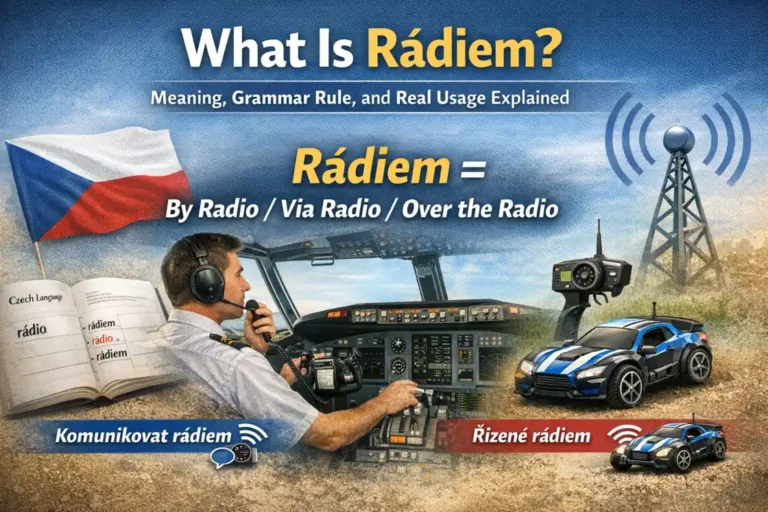
Language can look confusing when one word appears in a form you do not expect. That is why many readers stop when they see Rádiem and wonder what it means. At first glance, it may look like a brand name, a special term, or even a misspelling. In reality, it is a useful language form connected to the word rádio. Once you understand that connection, the whole topic becomes much easier to follow.
This article explains the meaning of Rádiem, the grammar rule behind it, and the kinds of real situations where it appears. The goal is to make the subject simple, clear, and practical for everyday readers. Whether you found the word in a sentence, in a translation, or in technical writing, this guide will help you understand what it is saying and why the form matters.
The Meaning of Rádiem
The clearest way to explain Rádiem is to say that it usually means by radio, via radio, or over the radio. It comes from the base noun rádio, which means radio. So the core idea does not change completely. What changes is the role of the word inside the sentence. Instead of naming the object in a basic way, the form Rádiem shows that radio is being used as the means, method, or channel for something.
That difference is small in appearance but important in meaning. A person may talk about a radio using the basic noun, but they may describe something happening through radio communication by using Rádiem. This is why the word often appears in sentences about signals, control, communication, and technical action. It is not just pointing to the device itself. It is showing how something happens through that medium.
The Grammar Rule Behind the Word
To understand why the word changes form, it helps to remember that some languages change noun endings based on sentence function. Czech does this in a regular and meaningful way. In this case, Rádiem is the form used when the noun shows the instrument or means used to carry out an action. English usually handles this idea with short helper words like by, with, or through. Czech often expresses that same idea by changing the ending of the noun.
That is why rádio becomes Rádiem in the right context. The change is not random, and it is not decorative. It tells the reader that radio is the channel, tool, or method involved. Once this rule is understood, the word no longer feels strange. It becomes a very logical part of the sentence, and readers can see why the form is useful rather than confusing.
Why This Rule Matters in Real Language
This grammar point matters because it changes the focus of the word. When someone uses rádio, they may simply be naming a radio. When they use Rádiem, they are usually showing that radio is actively involved as the means of contact, control, or communication. That shift makes the sentence more precise. It tells the reader not just what thing is being mentioned, but how the action is being carried out.
This is one reason the word appears in practical fields more than in casual chatter. Technical language often needs exact meaning. A sentence about a pilot, a signal system, or a remote device benefits from a form that clearly shows method. Instead of using extra words to explain the connection, the language places that meaning inside the noun ending itself. That is one of the reasons this form is worth understanding.
Real Usage and Natural Context
The easiest way to understand Rádiem is to look at the situations where it appears naturally. It often shows up in technical and practical settings such as aviation, transport, communication systems, electronics, or remote control. In these contexts, people are often describing information being sent, instructions being received, or machines being guided through radio contact. The word fits these situations because it clearly expresses radio as the working medium.
You may see the form in expressions like these:
- komunikovat rádiem
- řízený rádiem
- ovládaný rádiem
- spojený rádiem
Each example carries the idea of something happening through radio communication or radio control. Even if a reader does not know much Czech, the pattern becomes easier to recognize once these examples are explained in simple language.
Rádiem Is Not a Separate Mystery Term
Because unusual words often appear online without much context, some readers assume Rádiem must be the name of a platform, product, or modern concept. That can happen when the word is seen in a headline or in a sentence that has been translated poorly. But the stronger and more accurate explanation is grammatical. Rádiem is best understood first as a form of rádio, not as a completely separate idea with its own unrelated meaning.
That does not mean the word can never appear in a special title or a branded phrase somewhere. Almost any word can be reused in a name. Still, if you are writing an informative article, the main focus should stay on what the word truly does in language. Readers benefit more from a careful explanation of meaning and sentence use than from guesses about modern branding or invented wider meanings.
The Difference Between Rádiem and Rádio
A simple comparison helps here. Rádio is the base word. It names the radio itself, whether you mean radio broadcasting or a radio receiver. Rádiem is the form used when radio becomes the means through which something happens. This difference may seem small, but it changes the direction of the sentence. One form names the thing, while the other shows the role that thing plays.
This is why a clear article should explain both forms together. If a reader only sees Rádiem without learning about rádio, the meaning can feel incomplete. But once the base noun and the changed form are placed side by side, the logic becomes easy to follow. The article becomes stronger because it does not treat the word like a mystery. Instead, it shows the reader how the language works in a natural and grounded way.
Common Confusions Around the Word
One reason people search for Rádiem is that it looks similar to other words. Some readers confuse it with radium, while others connect it to different words that begin with a similar sound. This happens easily when a person meets the term out of context or without accent marks. A helpful article should clear up that confusion early. Rádiem belongs with rádio, not with chemistry, geometry, or unrelated scientific terms.
Another common point of confusion comes from broad claims made on the internet. Some pages present unusual foreign-language forms as if they are large concepts with many hidden meanings. That can make a simple word seem more mysterious than it really is. In this case, a clear explanation is far more useful. Readers usually want to know what the word means in plain English, how the grammar works, and where the word is naturally used. That is the information that actually helps them.
Why People Search for Rádiem
Most people search for Rádiem because they have seen it somewhere and want a fast answer. They may have found it in a translated sentence, in technical content, in educational material, or in a phrase related to communication. The word stands out because it is not familiar to English readers, and the accent mark makes it look even more specific. That first moment of confusion is often what leads a person to search for a simple explanation.
There is also a second reason people look it up: they want to know whether it is just a word form or something larger. A good article should answer that directly. It should say that the term is mainly a language form built from rádio, then move into the grammar rule and real examples. That structure works well because it gives the reader a clear starting point and then adds depth without making the article feel heavy or difficult.
How to Explain Rádiem Clearly
The best explanation is usually the shortest honest one. You can say that Rádiem means by radio or via radio when radio is the method used to communicate, control, or connect something. Then you can add that it comes from rádio and changes form because of grammar. These two points together give readers both meaning and structure. They learn what the word says and why it says it that way.
This approach also makes the topic easier for a worldwide audience. Many readers do not want a long grammar chart first. They want a natural explanation that feels useful right away. Once they understand the basic meaning, they are more open to learning the grammar rule behind it. That is why a strong article should begin with meaning, then move into form, then close with examples and practical understanding.
Final Thoughts
Rádiem may look unusual at first, but it becomes clear once you see its connection to rádio. It is best understood as a useful Czech form that shows radio acting as the means or medium of an action. In plain English, that usually comes across as by radio, via radio, or over the radio. This makes the word especially common in communication, control, and technical settings where exact meaning matters.
The most helpful way to write about the term is to stay simple, accurate, and direct. Explain the base word, explain the grammar rule, and show a few natural examples. That gives readers a complete understanding without making the topic seem larger or stranger than it really is. In the end, Rádiem is a good example of how one small ending can carry a lot of meaning and make a sentence more exact.
Frequently Asked Questions (FAQs)
What does Rádiem mean?
Rádiem usually means by radio, via radio, or over the radio. It shows that radio is the medium used in the action.
Is Rádiem the same as rádio?
No, they are related but not identical. Rádio is the base noun, while Rádiem is the form used when radio functions as the means.
Is Rádiem a separate word with a new meaning?
Not in the main sense. It is better understood as a grammatical form of rádio rather than a fully separate concept.
Why does the word change from rádio to Rádiem?
The ending changes because Czech uses different noun forms to show sentence role. Here, the form marks radio as the method or channel.
How do you translate Rádiem into English?
The best natural translations are by radio, via radio, or through radio communication. The exact choice depends on context.
Where is Rádiem commonly used?
It appears often in communication, aviation, electronics, transport, and remote control situations. These are places where radio acts as a working medium.
Can Rádiem be used in everyday language?
Yes, especially when talking about contact, signals, or control through radio. It is practical, not only formal.
Is Rádiem hard for beginners to understand?
Not once it is explained simply. The main idea is that the word shows something happening through radio.
Does Rádiem refer to a radio device or radio communication?
It can relate to either, depending on context. The key point is that radio is functioning as the means in the sentence.
Can Rádiem appear in remote-control phrases?
Yes, very often. It fits naturally in expressions about objects being guided or controlled through radio signals.
Should Rádiem be confused with radium?
No, it should not. Those belong to different meanings, and Rádiem belongs with rádio, not chemistry.
Why do readers search for Rádiem online?
Most are trying to understand a sentence, check the meaning, or learn why the word looks different from rádio.
FOR MORE : INSIDE FAME
