


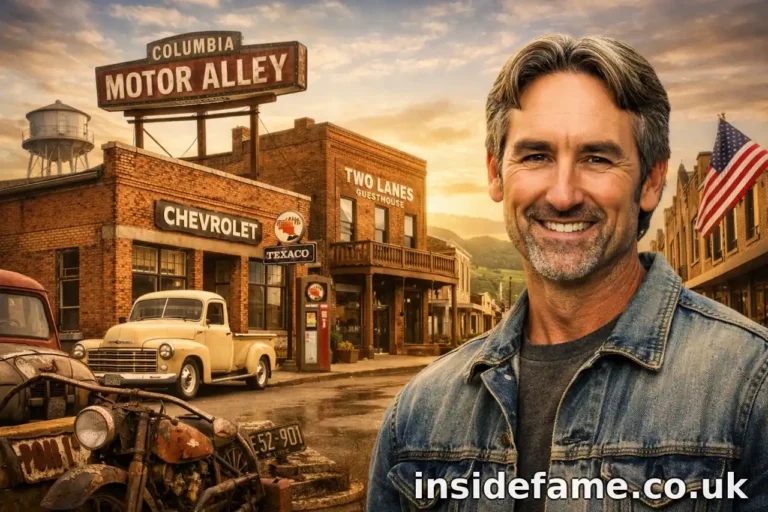
If you search for Mike Wolfe Passion Project, you quickly find that the phrase is bigger than one building. It points to a pattern that runs through Mike Wolfe’s public life: he does not just collect old things, he tries to save the places that gave those things meaning. From his work on American Pickers to his preservation efforts in Columbia, Tennessee, Wolfe has built a reputation around rescuing overlooked pieces of American history and turning them into living, useful spaces again. Official pages for Columbia Motor Alley and Two Lanes frame that mission clearly, linking his love of transportation history, old buildings, and small-town Main Streets.
For readers trying to understand the real story behind Mike Wolfe Passion Project, the best way to think about it is this: his restoration work sits at the crossroads of antiques, community memory, tourism, and economic revival. Columbia Motor Alley is the clearest expression of that idea, but it is not the only example. Two Lanes Guesthouse, his broader “Two Lanes” brand, and his small-town advocacy all show the same worldview—preserve what matters, reuse it thoughtfully, and keep Main Street culture alive instead of replacing it with something generic.
Quick Information Table
| Detail | Information |
|---|---|
| Full name | Mike Wolfe |
| Known for | Creator and star of American Pickers |
| Core public identity | Picker, antiques dealer, preservation-minded entrepreneur |
| Official store brand | Antique Archaeology |
| Preservation focus | Historic buildings, transportation spaces, Main Street reuse |
| Key Tennessee project | Columbia Motor Alley |
| Motor Alley building type | 1947 Chevrolet dealership |
| Motor Alley location | 801 Woodland Street, Columbia, Tennessee |
| Related Columbia project | Two Lanes Guesthouse |
| Guesthouse setting | One-bedroom loft above a bicycle shop in an 1857 brick building |
| Public mission theme | Reviving small-town spaces through restoration and reuse |
| Family details publicly confirmed | He has a daughter, Charlie; major private family details are limited in reliable public sources |
Who Is Mike Wolfe?
Mike Wolfe is best known as the creator and longtime face of American Pickers, but his public profile goes well beyond television. History describes him as a lifelong picker who has been hunting for hidden treasure since childhood, and CBS’s feature on Wolfe makes clear that he sees value not only in collectibles, but also in the places and people connected to them. That is important because the phrase Mike Wolfe Passion Project makes the most sense when you understand him as both a collector and a preservation-minded storyteller.
Early Life and Background
Wolfe’s early life helps explain why restoration became such a natural extension of his career. In the CBS profile, he says he grew up in a family where money was tight, raised by a single mother after his father left when he was very young. He also recalls finding a discarded bicycle as a child and realizing that what others threw away could still have value. That childhood instinct—to notice worth where others see neglect—shows up again in his building projects, especially in the way he talks about forgotten dealerships, service stations, and Main Street storefronts.
Education and Personal Details
Publicly available, trustworthy coverage says much more about Wolfe’s early picking life and career than it does about his formal education. Reliable sources reviewed here do not provide a well-documented academic background, so it is better not to overstate that part of his biography. What is publicly supported is that he has a daughter named Charlie, and recent reporting and public posts have also referenced his mother Rita and his close family ties, while more private family details remain understandably limited.
Why “Passion Project” Fits
The reason the term Mike Wolfe Passion Project resonates is that Wolfe himself consistently frames his preservation work emotionally, not just commercially. On the official Columbia Motor Alley page, he connects transportation history and historic preservation in one sentence and says he hopes the project inspires others to imagine what forgotten places could become again. In the CBS interview, he says old buildings “speak” to him and that some of these places matter deeply to their communities even when they are no longer economically useful in their original form.
Columbia Motor Alley
The project most directly tied to the keyword is Columbia Motor Alley in Columbia, Tennessee. Official tourism and brand pages identify it as a restored or actively revived 1947 Chevrolet dealership in the city’s historic Motor Alley District. The site is located at 801 Woodland Street, and local tourism pages connect it with recurring community events such as Columbia Cars & Coffee, which gives the property an active public role instead of leaving it as a private vanity restoration.
What makes Motor Alley especially significant is that it reflects Wolfe’s interest in both cars and place-making. The official project language is not just about nostalgia; it is about giving an abandoned transportation site a second life. That matters because older car dealerships and service spaces once formed part of everyday American commercial life, and restoring one preserves more than a building shell—it preserves a recognizable piece of regional identity. Wolfe’s framing suggests that the project is meant to function as a reminder that preservation can still be practical, visible, and community-facing.
Restoration Work and Public Use
Coverage from Parade and local tourism sources shows that Columbia Motor Alley is not frozen in time as a museum piece. It has continued evolving, with restoration updates, visible merchandise or visitor access, and recurring public events. Parade reported on Wolfe sharing repairs after an accident at the site, while Visit Columbia lists the building as the home of Columbia Cars & Coffee from April through October. That blend of repair, reuse, and public programming is a major reason this project stands out: the building is not simply being saved, it is being brought back into the daily rhythm of the town.
Two Lanes Guesthouse
A second major part of the Mike Wolfe Passion Project story is Two Lanes Guesthouse in Columbia. Official Antique Archaeology pages describe it as a one-bedroom loft above a bicycle shop inside an 1857 two-story brick building, about 1,100 square feet, designed to reflect Wolfe’s Americana style. The site says this is the first time he has used his experience selling to designers and decorators to create a space for other people to stay in and enjoy. That makes the guesthouse more than lodging; it becomes an immersive preservation experience.
Two Lanes Guesthouse also clarifies Wolfe’s broader mission. The official copy says the goal is to draw people out of major hotels and back onto Main Streets, reconnecting them with the pace and feeling of small-town life. That is one of the strongest clues about what links his projects together. Columbia Motor Alley preserves a transportation landmark, while the guesthouse gives visitors a way to physically experience the kind of historic downtown environment Wolfe has been advocating for. One project revives a place; the other turns that restored setting into a lived experience.
Community Impact
When people ask whether Mike Wolfe’s restoration work matters beyond fans of American Pickers, the strongest answer is yes. In the CBS interview, Wolfe speaks directly about trying to save towns, not just objects, and local tourism materials position Columbia Motor Alley as part of the city’s visitor appeal. Restored places create foot traffic, strengthen a destination identity, and give local businesses more reasons to benefit from visitors. Even when hard revenue numbers are not publicly available, the pattern is easy to see: visible preservation can raise attention, tourism interest, and civic pride.
There is also a cultural impact that is harder to measure but just as important. Wolfe’s projects carry an argument: that American history is not only found in museums, but in repaired facades, reused lofts, old gas pumps, dealership floors, handmade signs, and neighborhood gathering spaces. His restoration work suggests that the strongest communities are not the ones that erase their past, but the ones that find new uses for it. That is why the keyword Mike Wolfe Passion Project tends to attract readers interested in preservation, Americana, travel, architecture, and small-town revival all at once.
Connection to Antique Archaeology and American Pickers
Wolfe’s television brand and his restoration work support each other, but they are not the same thing. American Pickers made him famous for finding “rusty gold,” while Antique Archaeology gave him a storefront identity; however, his preservation projects reveal how he thinks beyond objects themselves. History’s own cast page says that after his family, his full-time passion is preserving as much of small-town America as he can by reclaiming, restoring, and reinvigorating old buildings. That statement connects the public TV figure directly to the restoration narrative behind Columbia Motor Alley and Two Lanes Guesthouse.
Marriage, Family, and Public Life
Readers often search biographical angles alongside project keywords, so it helps to address them carefully. Public reporting confirms Wolfe is a father to a daughter named Charlie, and recent coverage has shown him sharing family moments involving Charlie and his mother Rita. Older celebrity coverage has linked him to a previous marriage with Jodi Faeth, but the most reliable current sources in this review focus far more on his role as a father and his professional work than on private relationship details. For an article centered on Mike Wolfe Passion Project, the safer and more useful angle is that family, memory, and home clearly shape the emotional tone of his restoration work.
Financial Growth and Business Angle
Public, high-quality sources reviewed here do not offer a fully verified, up-to-date net worth figure that would meet the same standard as the project details themselves, so it is better to avoid presenting a hard number as fact. What can be said with confidence is that Wolfe has built multiple connected ventures—television, retail, branded merchandise, destination lodging, and historic property restoration—and that these projects position him as both a media personality and a preservation entrepreneur. In practical terms, his financial growth appears to come not from one single brand lane, but from turning his knowledge of Americana into a network of businesses and destinations.
Why This Topic Keeps Growing
The search appeal of Mike Wolfe Passion Project comes from layered reader intent. Some people want a simple answer about Columbia Motor Alley. Others want to know whether Wolfe is just a TV personality or a serious preservation advocate. Still others are searching for travel ideas, Americana design inspiration, or a biographical explanation for why he keeps investing in old places. The topic keeps growing because it touches all of those interests at once, and because his official projects continue to give people something concrete to visit, follow, and talk about.
Final Thoughts
At its core, Mike Wolfe Passion Project is about restoration with a point of view. Mike Wolfe does not seem interested in saving old buildings simply because they are old. He is interested in what they represent: the working history of American towns, the stories built into their walls, and the possibility that reuse can be more powerful than demolition. Columbia Motor Alley is the clearest symbol of that effort, while Two Lanes Guesthouse expands the idea into hospitality and lived experience. Together, they show why Wolfe’s preservation work continues to draw interest from fans, travelers, and readers who care about historic places and community identity.
Frequently Asked Questions
What is Mike Wolfe Passion Project?
The phrase usually refers to Mike Wolfe’s historic preservation work, especially Columbia Motor Alley in Columbia, Tennessee. It can also include related efforts such as Two Lanes Guesthouse and his broader small-town preservation message.
What is Columbia Motor Alley?
Columbia Motor Alley is a 1947 Chevrolet dealership in Columbia’s historic Motor Alley District. It is publicly listed at 801 Woodland Street and is tied to local events like Columbia Cars & Coffee.
Why is Columbia Motor Alley called a passion project?
The official project page describes it that way and explains that Wolfe’s love of transportation history and historic preservation come together there. The wording emphasizes imagination, reuse, and bringing forgotten places back to life.
Is Mike Wolfe more than just an antiques picker?
Yes. History’s official cast page says that after family, his full-time passion is preserving small-town America through reclaimed and restored buildings. CBS also profiled him as someone trying to save towns, not only collectibles.
What is Two Lanes Guesthouse?
Two Lanes Guesthouse is Mike Wolfe’s loft-style lodging in Columbia, set inside an 1857 brick building above a bicycle shop. It was designed to give guests a direct experience of historic Main Street life through curated Americana design.
How does Two Lanes Guesthouse relate to Mike Wolfe Passion Project?
It extends the same restoration philosophy behind Motor Alley. Instead of only preserving a building, it lets visitors stay inside a restored historic setting and experience the type of small-town environment Wolfe wants people to appreciate.
Does Mike Wolfe talk publicly about why he restores old buildings?
Yes. In the CBS interview, he says old buildings “speak” to him and argues that communities should try to save places that still matter. Those remarks are some of the clearest statements of his preservation philosophy.
Where is Mike Wolfe from?
Public biographies identify Wolfe with Illinois and Iowa, and his career story is deeply tied to the Midwest. History’s official page and CBS both describe his long roots in picking and small-town America.
Does Mike Wolfe have children?
Yes. Public reporting confirms that he has a daughter named Charlie. That detail appears in multiple mainstream entertainment reports.
Is Mike Wolfe still involved in Antique Archaeology?
Yes, Antique Archaeology remains a central part of his public brand. History’s official cast page still identifies the specialty shop as one of the best-known parts of his business identity.
Is Mike Wolfe’s net worth publicly confirmed?
Not in a way that is solid enough to present as a definitive fact from top-tier sources reviewed here. It is safer to describe him as a successful media and preservation entrepreneur rather than attach an uncertain number.
Why does this topic rank well with readers?
Because it combines biography, restoration, travel, architecture, Americana, and community revival in one topic. Readers are not only searching for Mike Wolfe the TV figure; they are searching for the meaning and impact behind the projects he keeps building.
FOR MORE : INSIDE FAME
