


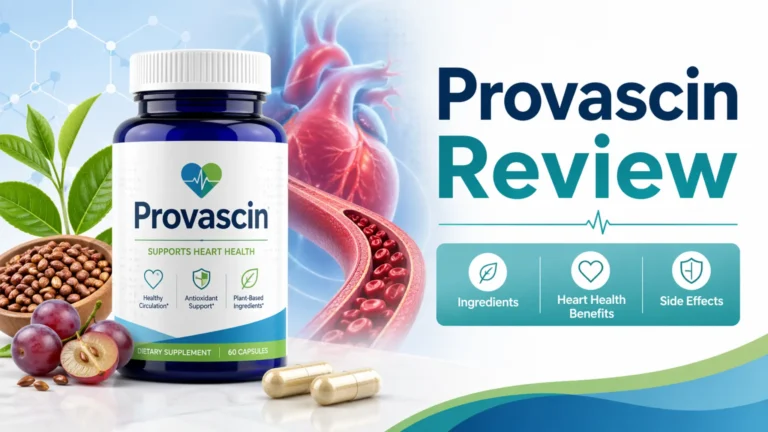
Heart health supplements can be hard to judge because many of them mix strong claims with very little detail. Provascin stands out because it is sold as a broad cardiovascular support formula rather than a single-ingredient product. It combines nutrients, plant compounds, and mushroom extract in one capsule, which makes it sound complete at first glance. Still, a smart review needs to go beyond the label and ask a simple question: does the blend make sense for real people who want to support their heart, circulation, cholesterol, and overall wellness?
This review looks closely at what Provascin contains, what each main ingredient may do, and where the likely benefits stop. It also looks at safety, possible side effects, and who should be careful before taking it. The goal is not to praise or dismiss the product. It is to explain, in plain language, what Provascin may offer, what remains uncertain, and whether it looks like a reasonable choice for adults who want extra support alongside healthy habits and proper medical care.
What Provascin is and how it is positioned
Provascin is marketed as a multi-ingredient supplement for cardiovascular support. In simple terms, that means it is meant to support the heart and blood vessels instead of focusing on just one issue. Public product listings describe it as a formula for heart tissue maintenance, healthy circulation, cholesterol support, and general vascular wellness. It is also presented as suitable for adults looking for long-term support, not just short-term use during a specific health event.
That broad positioning is both a strength and a weakness. It is a strength because many people want one product that covers several areas at once. It is a weakness because the more goals a supplement claims to support, the harder it becomes to judge whether one formula can truly do all of them well. In the case of Provascin, the blend looks carefully designed, but the finished product itself does not appear to have the same kind of strong published human research that exists for some of its individual ingredients.
Provascin ingredients at a glance
The formula combines several well-known support compounds with a few ingredients that are less commonly seen in everyday heart formulas. The main active ingredients commonly listed for Provascin include:
- L-carnitine
- Alpha-ketoglutaric acid
- Chaga mushroom
- Coenzyme Q10
- Betaine HCl
- Alpha-lipoic acid
- Grape seed extract
- Green tea extract
This mix suggests three main goals. First, it aims to support energy production in heart cells. Second, it aims to provide antioxidant support for blood vessels and tissues. Third, it appears designed to support circulation and metabolic balance. On paper, that sounds useful. In practice, the value depends on how well each ingredient is supported, how much of it is present, and whether the doses are close to the amounts used in better-known studies.
L-carnitine and CoQ10 for heart energy
L-carnitine and CoQ10 are two of the most important ingredients in Provascin because both are tied to how cells make and use energy. The heart works all day, every day, and it needs a steady supply of fuel. L-carnitine helps move fatty acids into the mitochondria, where they can be used for energy. CoQ10 helps support the energy-making process inside those mitochondria. That is one reason these two ingredients often appear in heart support products.
Among the ingredients in Provascin, CoQ10 has the strongest reputation in cardiovascular support. It is often discussed in connection with heart failure, fatigue, and statin-related energy concerns. L-carnitine also has a long history in heart-related research, especially in older studies on recovery and energy metabolism. This does not mean Provascin is a proven treatment for heart disease. It means the formula includes two ingredients with a sensible role in a heart-support blend, and that gives the product more credibility than formulas built only around weak herbal claims.
Alpha-lipoic acid, grape seed, and green tea extract
Another important part of Provascin is its antioxidant side. Alpha-lipoic acid, grape seed extract, and green tea extract are all widely used for their potential role in reducing oxidative stress. Oxidative stress is often discussed in relation to blood vessel health, inflammation, and long-term wear on tissues. When a supplement includes these compounds, the idea is usually to support the inner lining of blood vessels and help the body manage cellular stress more effectively.
This part of the formula may be helpful for people interested in circulation and vascular support, but expectations should stay realistic. These ingredients are promising, yet their effects are usually modest, not dramatic. They are not a replacement for blood pressure treatment, cholesterol treatment, or lifestyle changes. In a product like Provascin, they make the formula more rounded, but they do not turn it into a miracle product. Their biggest value is likely as part of a broader support blend, not as a stand-alone answer to serious heart concerns.
Betaine and homocysteine support
Betaine is included because it is linked to homocysteine metabolism. Homocysteine is a natural compound in the body, but high levels have often been discussed as a possible marker linked with cardiovascular risk. Betaine helps the body process homocysteine, which is why it is sometimes used in formulas aimed at metabolic or vascular support. From a marketing point of view, that makes sense, because many people associate lower homocysteine with better heart health.
Still, this is one of the more complicated areas of the formula. Lowering homocysteine sounds helpful, but that does not always translate into a clear real-world heart benefit for every person. On top of that, betaine can be a mixed ingredient in broader wellness formulas because some data have raised questions about effects on blood lipids in certain settings. That does not make it a bad ingredient, but it does mean it should be viewed as a supportive piece of the formula rather than one of the major reasons to buy Provascin.
Chaga and alpha-ketoglutaric acid
Chaga mushroom and alpha-ketoglutaric acid make Provascin more unusual than many standard heart supplements. Chaga is often promoted for antioxidant support and immune balance. Alpha-ketoglutaric acid is tied to energy metabolism and cellular function. Together, they help give the product a broader wellness identity instead of making it look like a basic CoQ10 capsule with a few extras added in.
The problem is that these two ingredients are also among the least convincing parts of the formula when it comes to direct heart support. Chaga may sound impressive, but human evidence for direct cardiovascular benefit is still limited. Alpha-ketoglutaric acid has interesting biological roles, yet that does not automatically mean it delivers a clear day-to-day benefit in an oral supplement for average adults. These ingredients may still add supportive value, but they are not the main reason Provascin appears useful. In practical terms, CoQ10 and L-carnitine do more of the heavy lifting in the formula.
Potential heart health benefits
For people asking what Provascin may actually help with, the likely answer is broad support rather than strong symptom relief. The product may help support healthy cellular energy, circulation, and general cardiovascular function. Adults who feel they want a more complete formula than a single-ingredient supplement may like that it includes both energy-support compounds and antioxidant plant extracts. The blend also gives it a wider appeal for adults focused on aging, daily wellness, and long-term prevention habits.
That said, the possible benefits should be described carefully. Provascin may support heart health, but it is not a proven treatment for blocked arteries, heart failure, angina, or high blood pressure. It may help support healthy function in the background, especially if paired with exercise, a good diet, sleep, and routine medical follow-up. People looking for fast or obvious results may be disappointed. This seems more like a steady support product than a dramatic problem-solver.
What the formula gets right and where it falls short
One of the best things about Provascin is that the ingredient choices are not random. The formula follows a logical pattern. Some ingredients target heart cell energy, some aim to support blood vessels, and some add antioxidant coverage. That kind of structure is more thoughtful than many products that simply throw together trendy ingredients without any clear purpose. It also helps that Provascin is not sold as a stimulant or an extreme performance enhancer, which makes its tone feel more balanced and wellness-focused.
Where it falls short is the gap between ingredient logic and finished-product proof. It is one thing to say a formula is built from promising parts. It is another to show that the exact blend, in the exact amounts used, consistently improves outcomes in real people. That is the missing piece here. Provascin looks well designed, but it still depends heavily on what is known about its individual ingredients rather than on direct proof for the full formula as a whole.
Side effects and safety concerns
Most healthy adults who tolerate supplements well may have no major problems with Provascin, but side effects are still possible. Because it is a mixed formula, the most likely mild issues would be stomach upset, digestive discomfort, nausea, or sensitivity to one of the plant extracts. Some people also react differently to green tea extract or concentrated botanicals, especially when taken on an empty stomach. Even a product sold for heart support can feel too strong for people with sensitive digestion.
There are also more serious points to keep in mind. Green tea extract has been discussed in connection with liver concerns in high-dose supplement use. Chaga has raised kidney-related concerns in certain case reports, especially with heavy use. CoQ10 may interact with some medications, and plant compounds can sometimes affect blood clotting or how drugs are processed. That does not mean Provascin is unsafe for everyone. It means that a formula with several active compounds deserves more caution than a simple daily vitamin.
Who should be careful before using Provascin
Provascin is not a product to start casually if you already have a diagnosed medical condition or take prescription medicine for the heart, blood pressure, cholesterol, blood sugar, or clotting. People using blood thinners, those with liver or kidney concerns, and those who are pregnant or breastfeeding should be especially careful. The same applies to anyone with a seizure disorder, autoimmune condition, or a history of unusual supplement reactions.
In those cases, a quick discussion with a qualified health professional is the smart move. That is not just a routine warning. It matters more with Provascin because this is a blend, not a single ingredient. With blends, the risk is not only what each ingredient does alone, but how several active compounds may interact with the body at the same time. For healthy adults who take no major medication, the risk may be lower, but caution still makes sense.
Is Provascin worth trying?
Whether Provascin is worth trying depends on what kind of support you want. If you want a broad heart wellness formula with CoQ10, L-carnitine, plant antioxidants, and a more complete ingredient profile than a basic supplement, Provascin has real appeal. It looks more thoughtful than many products that rely only on buzzwords. For someone who prefers all-in-one support, it may feel convenient and practical.
If, however, you want the clearest evidence-based choice, a more focused product may make more sense. A dedicated CoQ10 supplement, for example, is easier to understand and easier to judge. Provascin offers breadth, but that breadth also creates uncertainty. In other words, it may be a reasonable option for general support, but it is not the cleanest choice for someone who wants the most direct, easiest-to-evaluate approach.
Final thoughts
Provascin is a serious-looking heart support supplement with a formula that appears more thoughtful than average. Its strongest points are the inclusion of CoQ10 and L-carnitine, along with a supporting cast of antioxidant and metabolic ingredients. The blend makes biological sense, and it may offer useful everyday cardiovascular support for adults who want more than a simple one-note supplement. It also has a calmer, more wellness-oriented profile than products that promise dramatic results.
At the same time, the product should be judged honestly. The full formula does not appear to have strong direct human proof behind it, and several ingredients seem more supportive than decisive. That means Provascin is best viewed as a possible helper, not a proven solution. For the right person, it may be a solid addition to healthy habits. For anyone with medical issues, major symptoms, or prescription drug use, it should be approached carefully and never treated as a replacement for real medical care.
Frequently Asked Questions (FAQs)
What is Provascin used for?
Provascin is used as a heart and circulation support supplement. It is generally marketed to support cardiovascular wellness, energy production, and overall vascular health.
Does Provascin help heart health?
It may help support heart health because it includes CoQ10, L-carnitine, and antioxidant compounds. Still, it should be viewed as support, not as a treatment for heart disease.
What are the main ingredients in Provascin?
The main ingredients commonly listed include L-carnitine, CoQ10, alpha-lipoic acid, betaine, grape seed extract, green tea extract, chaga, and alpha-ketoglutaric acid.
Is Provascin a blood pressure supplement?
Not exactly. Some ingredients in the formula may support circulation and blood vessel function, but Provascin is not a direct replacement for blood pressure medicine.
Can Provascin lower cholesterol?
It may support overall cardiovascular balance, but it should not be expected to work like a prescription cholesterol drug. Results, if any, are likely to be modest.
Does Provascin contain CoQ10?
Yes, CoQ10 is one of the main ingredients in Provascin. It is one of the strongest parts of the formula because of its role in cellular energy support.
Are there side effects of Provascin?
Possible side effects may include stomach upset, nausea, or sensitivity to herbal extracts. People on medicines or with medical conditions should be especially careful.
Is Provascin safe to take every day?
Some adults may use it daily without problems, but daily use should still be thoughtful. Safety depends on your health status, medications, and how well you tolerate supplements.
Can I take Provascin with blood thinners?
That should be discussed with a healthcare professional first. Some ingredients in mixed heart formulas may affect clotting or interact with medications.
Is Provascin good for circulation?
It may support circulation because several ingredients are aimed at blood vessel function and antioxidant balance. Even so, results are usually supportive, not dramatic.
Who should avoid Provascin?
People who are pregnant, breastfeeding, taking prescription heart or blood-thinning medicine, or living with liver or kidney issues should be cautious before using it.
Is Provascin worth buying?
It may be worth buying if you want a broad heart support formula in one product. If you prefer a simpler and easier-to-judge option, a single-ingredient supplement may be better.
FOR MORE : INSIDE FAME
