


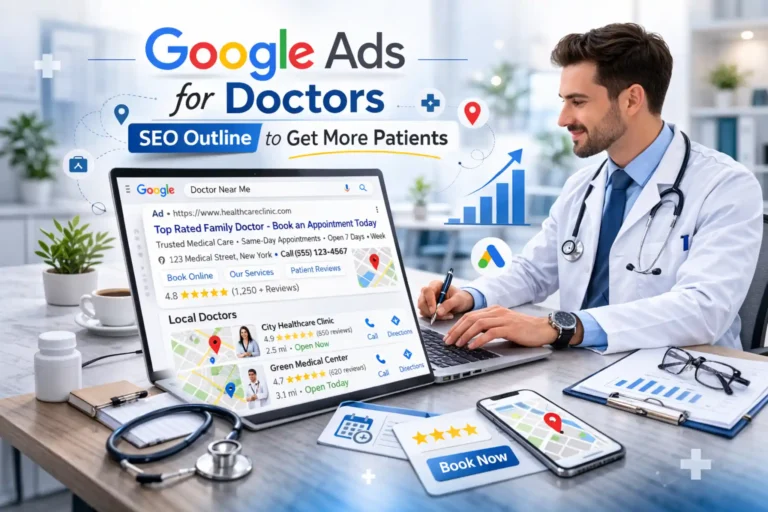
In 2026 more than 70 % of potential patients research doctors and clinics online before booking an appointment. They type queries such as “doctor near me,” read reviews and compare providers through Google Maps, AI‑generated summaries and local search results. If a clinic does not appear during this search phase, it is effectively invisible to the patient.
Two complementary strategies dominate this digital front door:
-
Google Ads (pay‑per‑click) – paid search ads that put a practice at the top of results for high‑intent queries. Google Ads deliver instant visibility and allow physicians to target specific services, locations and appointment types.
-
Search engine optimization (SEO) – organic optimisation of websites and local profiles to rank in Google’s Map Pack and organic results. Medical SEO is highly regulated and requires strong expertise, authoritativeness and trust (E‑E‑A‑T) signals.
This guide explains how Google Ads for doctors work and how to build an SEO‑aligned outline to attract more patients. It draws on recent 2025‑26 benchmarks and recommendations from leading healthcare marketing sources.
Why Google Ads matter for doctors
Instant visibility when patients are ready to act. Google Ads allow clinics to appear at the exact moment someone searches for a provider. A person typing “dermatologist near me” has already decided to see a doctor. Unlike print or billboard advertising, where many viewers will never need your services, Google Ads reach people who actively need care.
Targeted local audience and budget control. Ads can target searchers within a specific radius (e.g., 5–10 miles) and display the clinic’s location, phone number and hours through ad extensions. Doctors control daily or monthly budgets and can pause or adjust campaigns when necessary.
Measurable ROI. Benchmarks show that healthcare click‑through rates range from 5–8 % and the average cost per click is about $5.64, though specialty costs vary (primary care $3–$8, dermatology $8–$25, cosmetic surgery $50 +). Even with higher costs, the lifetime value of a new patient often justifies the spend.
Rapid response to seasonal or urgent needs. Google Ads campaigns can be launched quickly to promote flu‑shot clinics, same‑day appointments or urgent care services. Social media and SEO build long‑term brand awareness, but Google Ads deliver immediate results for time‑sensitive services.
Campaign types and structure
Search campaigns
Search campaigns are the foundation of medical PPC. They target people actively searching for services like “urgent care near me” or “pediatric dentist appointment”. Ads appear at the top of results, and budgets are focused where they convert best. Use exact and phrase match keywords to control relevance and avoid broad matches unless testing with a larger budget.
Call‑only and Local Services Ads (LSAs)
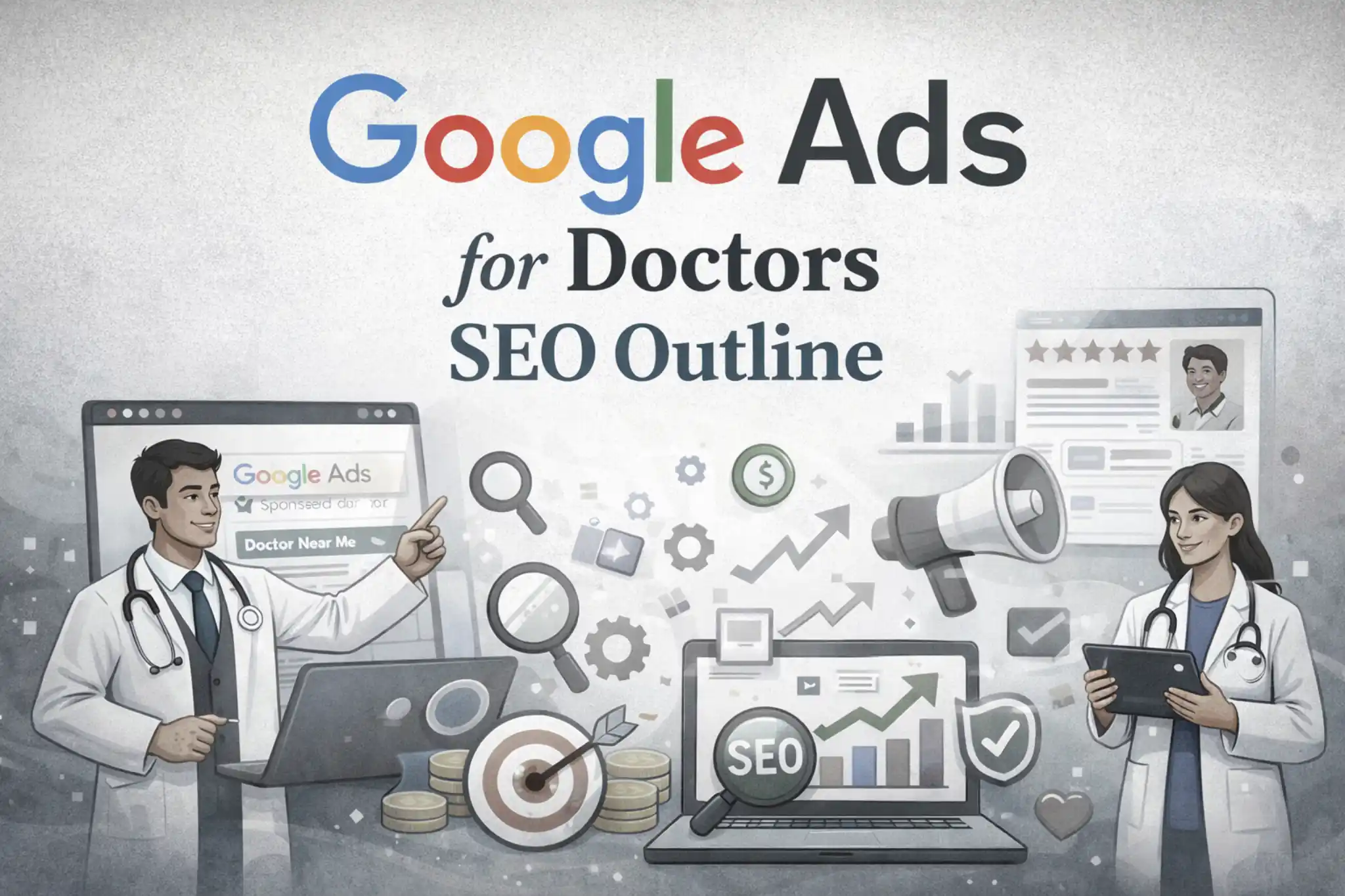
Call‑only campaigns generate immediate phone calls — ideal for urgent care and appointment booking. Local Services Ads (LSAs) display a Google Guaranteed badge and list the clinic’s phone number, hours and ratings. LSAs are prominent in high‑trust industries such as healthcare and usually deliver high‑intent leads.
Display and video campaigns
Display ads reinforce brand presence across medical websites and help with remarketing to visitors who did not convert. Video ads (e.g., YouTube) build trust by showing providers and explaining procedures; they work well for awareness and patient education but typically produce fewer immediate bookings..
Remarketing
Remarketing reconnects with people who visited your website but did not book an appointment. Tailored ads address specific patient needs, prompting them to schedule care. Medical remarketing must comply with Google’s personalization restrictions: ads cannot imply knowledge of a person’s health condition, and remarketing may be limited for sensitive services.
Ad extensions
Extensions add vital information, improving local SEO and click‑through rates:
-
Call extensions enable click‑to‑call and are critical for healthcare conversions.
-
Location extensions display the clinic’s address and map pin, improving local relevance.
-
Sitelink extensions link to specific services or doctor bios.
-
Callout extensions highlight trust statements such as “Same‑Day Appointments” or “Most Insurances Accepted”.
Keyword research and high‑intent targeting
High‑intent keywords drive bookings. In healthcare, winning clicks isn’t about volume; it’s about getting the right click. High‑intent queries — e.g., “book pediatrician near me,” “urgent care open now” — signal readiness to act. Low‑intent queries like “causes of ear pain” are informational and rarely convert.
Patient language matters. Patients don’t use medical jargon. They search using plain phrases such as “child fever urgent care”. Identify high‑intent keywords by listening to patient calls, reading FAQs and using research tools (Google Keyword Planner, SEMrush, Ahrefs) to filter for terms containing modifiers like “near me,” “open now” and “appointment”.
Combine location + service + action. Combine your specialty, location and desired action for maximum relevance. For example, “emergency dentist open today” or “telehealth psychiatrist appointment” reflect immediate intent. Use exact and phrase match keywords to maintain control; avoid broad match unless you have ample budget for testing.
Use negative keywords. Add negative keywords such as “free,” “jobs,” “schools” and “home remedy” to avoid paying for irrelevant clicks.
Creating effective Google Ads campaigns – step by step
-
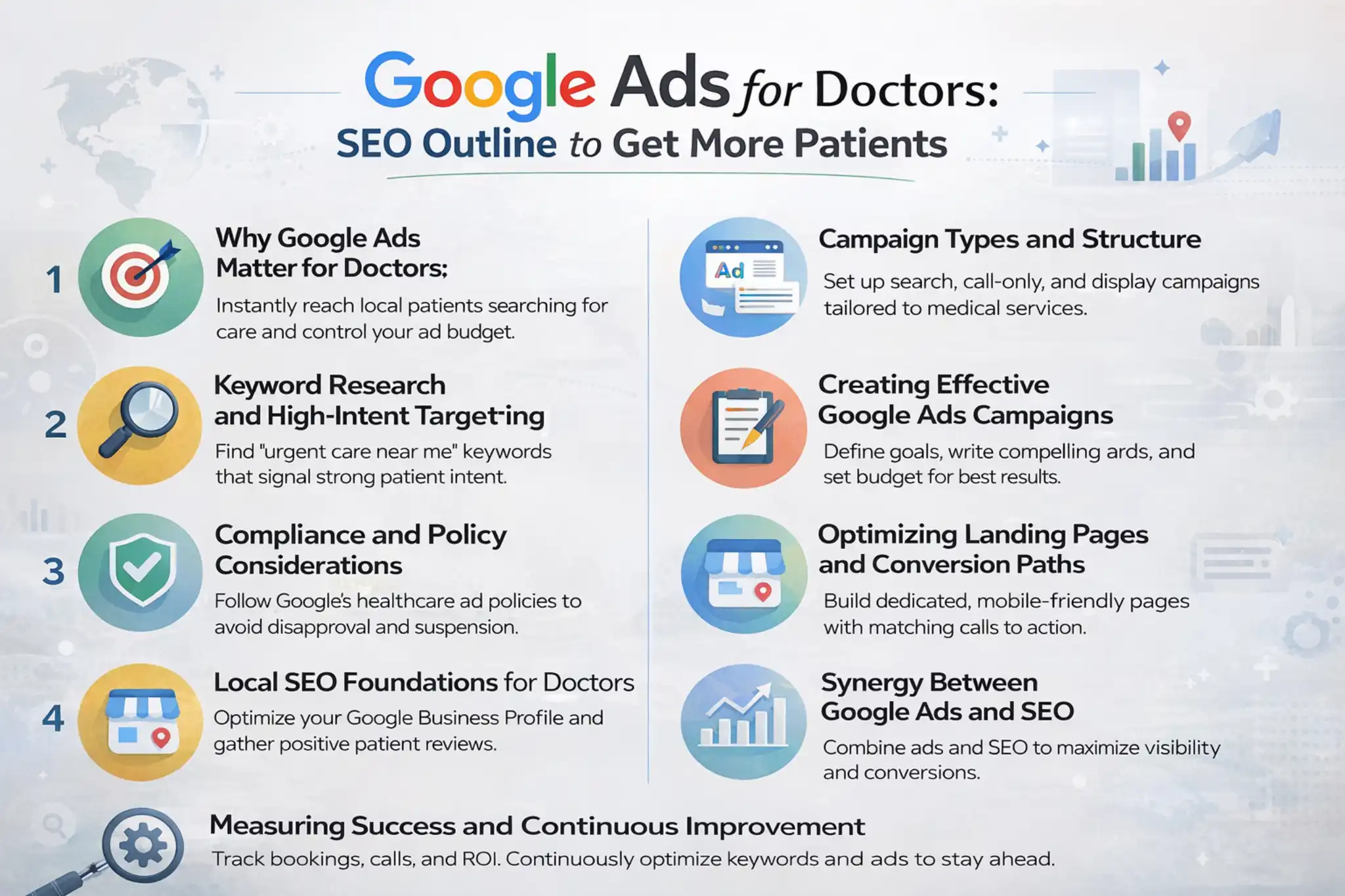
Define your goal. Typical goals include driving appointment bookings, increasing phone inquiries, promoting same‑day services or building awareness for a specialty. Clear goals guide ad copy, keyword selection and bidding.
-
Target the right local audience. Use radius or zip‑code targeting to show ads only to people within a reasonable driving distance. Exclude areas you cannot serve due to insurance or logistics.
-
Choose the best campaign type. For most doctors, search campaigns, call‑only campaigns and Local Services Ads are most effective. Use display and video campaigns for brand awareness or remarketing.
-
Select high‑intent keywords. Use exact/phrase match terms with your specialty, location and action words. Avoid broad match unless you have budget to test.
-
Write compelling ad copy. Keep language simple and patient‑friendly. Highlight urgent benefits (“Same‑Day Appointments,” “Open Weekends”) and include your location and phone number. Use strong calls to action (“Book Now,” “Schedule Today”).
-
Set a realistic budget. Start with a daily or monthly budget you can sustain for 4–6 weeks. Use manual CPC bidding initially to understand which keywords convert best, then test automated bidding strategies like Target CPA or Maximize Conversions once you have sufficient conversions.
-
Add location and call extensions. Include your clinic’s address and click‑to‑call buttons to build trust and ease of access.
-
Create dedicated landing pages. Sending ad traffic to a generic homepage reduces conversions. Build pages tailored to each campaign with a headline matching the ad, service details, doctor credentials, trust signals (reviews, awards) and multiple contact options. Ensure pages are mobile‑friendly since over 60 % of healthcare searches happen on mobile devices.
-
Track every conversion. Set up call tracking, form submission tracking and online scheduling analytics. Measure not just leads but booked appointments and show‑ups.
-
Continuously optimize. Review search‑term reports weekly, adjust bids, test new ad variations and update negative keywords. Healthcare competition and cost per click can change quickly; continual adjustments ensure campaigns remain profitable.
Compliance and policy considerations
Healthcare advertising faces more stringent rules than most industries. Violations can cause ad disapprovals or account suspensions.
Avoid unsubstantiated claims and exploitation. Promising guaranteed results (e.g., “100 % effective cure”) violates Google’s policies. Ads must not exploit personal health struggles; phrasing like “Suffering from depression?” is prohibited, whereas “Psychiatrist accepting new patients” is acceptable.
Beware of before‑and‑after content. Weight‑loss and cosmetic surgery ads face strict restrictions and sometimes require specific disclosures.
Obtain necessary certifications. Telemedicine providers, online pharmacies, addiction‑treatment centers and clinics prescribing medications must obtain LegitScript certification before advertising; noncompliance can lead to immediate suspension.
Respect personalization restrictions. Google prohibits targeting based on sensitive health conditions. Ads should not imply knowledge of a user’s condition and may face remarketing limitations.
Handle disapprovals and suspensions promptly. Most violations trigger a warning with a 7‑day window to fix the issue. Address the problem completely before re‑submitting. Serious violations (e.g., unlicensed telehealth or false claims) can result in immediate suspension.
Optimizing landing pages and conversion paths
Conversion success hinges on landing pages that align with both paid and organic strategies. Key elements include:
-
Headline that matches ad copy and search intent.
-
Clear description of the specific medical service (e.g., cardiology, dermatology).
-
Provider credentials such as board certifications and experience.
-
Trust signals – patient reviews, hospital affiliations and awards.
-
Multiple contact options (phone, form, online scheduling).
-
Insurance information prominently displayed.
-
Mobile‑friendly design (critical because most healthcare searches are on mobile).
Ensure your landing pages comply with the same policies that govern ads: if a claim cannot appear in ad copy, it should not appear on the landing page either.
Local SEO foundations for doctors
Trust is the new ranking factor. In 2026, local SEO for doctors isn’t about stuffing keywords or blog posts; it’s about building medical trust at scale. Google evaluates doctors through multiple layers: Google Business Profile signals, website credibility, review patterns, brand mentions, citation consistency, user engagement and AI‑citation trustworthiness.
Google Business Profile (GBP) optimization
A clinic’s GBP remains the strongest local ranking lever. Core requirements include:
-
Correct primary medical category (e.g., “Dermatologist” or “Pediatrician”).
-
Accurate clinic name without keyword stuffing.
-
One verified location per physical practice.
-
Clear list of services and treatments.
-
Accurate business hours, including holiday updates.
-
Real photos of the clinic and staff (not stock images).
-
Regular posts and updates to signal activity.
Reviews and reputation signals
Reviews influence both rankings and patient decisions. Google prioritizes review velocity (consistent new reviews) over sheer count, the use of natural medical language, recency of feedback and whether the business owner replies to every review. Asking patients for reviews immediately after positive visits and responding publicly to all reviews builds trust.
On‑page SEO and E‑E‑A‑T
Medical websites are judged differently from general service sites. Best practices include:
-
Clear explanations of each service and treatment.
-
Prominent physician bios with credentials and certifications.
-
About pages that highlight medical experience and mission.
-
Patient‑friendly language (avoiding jargon) and structured internal linking.
-
Location‑specific content that matches the clinic’s service area.
Google requires robust E‑E‑A‑T signals (Experience, Expertise, Authoritativeness, Trustworthiness). These include doctor bios, real photos, privacy policies, contact details, consistent Name‑Address‑Phone (NAP) information and third‑party medical mentions.
Local content strategy and location pages
Rather than churning out generic blog posts, focus on targeted educational content: condition explanations, treatment comparisons, cost/insurance guides, pre‑ and post‑visit expectations and FAQs tied to real patient questions. Use question‑based headings so AI engines can easily cite your content.
Create one unique location page per clinic, with references to local hospitals and neighborhoods, embedded maps and appointment CTAs. Avoid fake “service area” pages; they can lead to penalties.
Local link building and citations
Focus on quality rather than quantity. Effective sources include medical directories, hospital affiliations, local health publications, community sponsorships, chambers of commerce and medical associations.
Answer‑engine optimization and AI search
Patients increasingly receive answers from AI platforms such as ChatGPT, Gemini and Perplexity. These models rely on the same trust signals as Google; they pull information from Google Maps listings, medical directories, reviews, clinic websites and community mentions. Optimise for answer engines by using question‑based headings and clear, accurate explanations.
Synergy between Google Ads and SEO
A well‑structured ads campaign supports SEO in several ways:
-
Validate keyword demand. Ads provide immediate feedback on which terms patients actually use and convert. This data informs your SEO keyword strategy.
-
Increase brand searches. Paid visibility leads to more people searching your clinic by name, signalling relevance to Google’s algorithms and improving organic trust.
-
Capture immediate appointment intent while SEO compounds. Ads deliver bookings now; SEO builds long‑term visibility that continues when ads are paused.
-
Feed conversion data back into SEO. Understanding which ad clicks lead to appointments helps refine website content and calls to action, improving SEO conversions.
To maximize synergy:
-
Separate campaigns by specialty and location. Avoid broad match terms and focus on exact/phrase match to align with SEO targeting.
-
Use dedicated landing pages for both ads and SEO, ensuring consistent messaging, services, credentials and trust indicators.
-
Maintain compliance across both channels — no misleading claims, guarantees or unsubstantiated outcomes.
-
Track conversions from both paid and organic sources; monitor calls, direction requests, brand search growth and conversion behaviour on service pages.
Measuring success and continuous improvement
Success in medical marketing is measured in booked appointments and improved patient outcomes, not just clicks or traffic. Key metrics include:
-
Appointment calls from Google Maps, direction requests and click‑to‑call conversions.
-
Form submissions and online scheduling completions, tracked via analytics.
-
Conversion rate (lead‑to‑patient) – not every lead becomes a patient, so track show‑ups and new patient records.
-
Cost per acquisition (CPA) and Return on ad spend (ROAS) – measure how advertising spend translates into new patient revenue.
-
Review velocity and sentiment, since patient feedback strongly influences rankings and conversions.
Use these insights to continuously adjust keywords, ad copy, bids and website content. Healthcare search landscapes change quickly, and sustained optimization is critical.
Conclusion
Digital healthcare marketing in 2026 is about being discoverable when and where patients need you. Google Ads offers immediate visibility and should be structured around high‑intent keywords, local targeting, compliant messaging and dedicated landing pages. At the same time, SEO builds long‑term trust and authority through optimized Google Business Profiles, authentic reviews, credible content, E‑E‑A‑T signals and robust local links.
The most successful practices combine both strategies: ads to validate demand and capture immediate appointments, and SEO to sustain growth and earn AI‑driven recommendations. By focusing on trust, compliance and patient‑centric content, doctors can transform online searches into lasting patient relationships.
Frequently Asked Questions (FAQs)
1. Why do most patients research doctors online first?
Because it’s fast and convenient, people compare locations, reviews and services on Google before trusting any clinic. If you don’t appear there, many patients never even consider you.
2. How do Google Ads help doctors get more patients quickly?
They place your clinic at the very top of results when someone searches for help, such as “doctor near me.” That immediate visibility turns more urgent searches into calls and bookings.
3. Are Google Ads only useful for large hospitals?
No, they work well for solo doctors, small clinics and multi-location groups. The difference is that smaller practices usually focus on a few high-value services and tight local areas.
4. What makes a search campaign effective for a medical practice?
Focused themes around real services, clear patient-friendly ads and strong local targeting. When these match what people search, your budget goes to the right visitors instead of random clicks.
5. When should a clinic use call-only or Local Services Ads?
Use them when patients need fast answers—urgent care, dental emergencies or same-day visits. These formats push your phone number forward so a worried patient can reach you in one tap.
6. Why is patient language so important in targeting?
Patients rarely use clinical terms; they search in everyday words like “child fever clinic.” Matching that language helps your ads show up for real people instead of just technical phrases.
7. What role do negative terms play in campaigns?
They block unwanted clicks from people looking for jobs, free care or information only. This keeps your budget focused on genuine appointment seekers instead of casual browsers.
8. How can doctors write ad copy that patients trust?
Use calm, clear wording that names the service, city and real benefits like flexible hours or weekend visits. Avoid big promises and make the next step—call or book—obvious.
9. Why are dedicated landing pages better than sending traffic to the homepage?
A dedicated page continues the exact promise from the ad and shows only relevant details. That focus makes it easier for a busy patient to understand, trust and book without confusion.
10. What compliance risks should clinics watch for in ads?
Risky areas include guaranteed cures, unapproved treatments and sensitive topics handled carelessly. Staying accurate, balanced and respectful helps protect both your account and your reputation.
11. How does online reputation affect paid performance?
Strong, recent reviews and a complete profile make patients far more likely to call after clicking an ad. A weak rating, in contrast, can quietly waste even the best-built campaigns.
12. How do paid campaigns and organic visibility support each other?
Paid ads capture urgent demand and reveal what patients respond to, while your organic presence builds long-term trust. Together they keep you visible now and harder to ignore in the future.
FOR MORE : INSIDE FAME
