


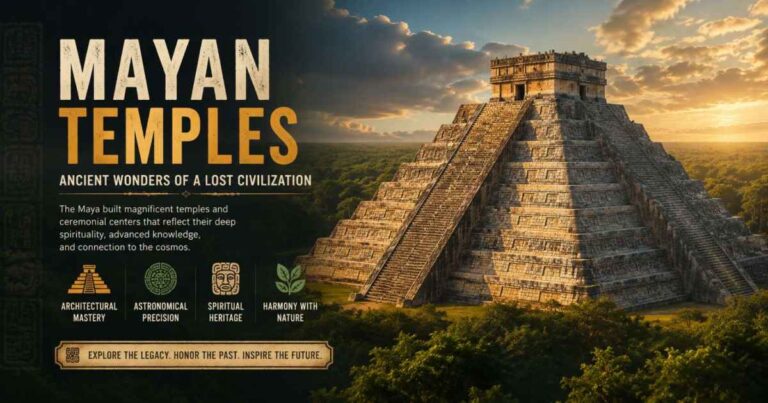
Mayan temples are far more than ancient stone monuments—they are enduring symbols of one of the world’s most sophisticated civilizations. Built centuries ago across present-day Mexico, Guatemala, Belize, Honduras, and El Salvador, these remarkable structures continue to fascinate archaeologists, historians, and travelers alike. In 2026, growing interest in Mayan archaeology, Mesoamerican history, cultural heritage, and sustainable tourism has made these ancient sites more popular than ever.
Whether you’re planning your first visit or simply want to learn more about the Maya, this complete guide covers the history of Mayan temples, their purpose, architectural brilliance, famous sites, hidden discoveries, travel tips, and why they remain culturally important today.
What Are Mayan Temples and Why Were They Built?
The Mayan civilization flourished throughout Mesoamerica, reaching its peak during the Classic Period (approximately 250–900 AD). During this era, Mayan cities constructed impressive temples that served as much more than places of worship.
These towering step pyramids functioned as the centers of religion, politics, astronomy, education, and royal authority. Unlike modern religious buildings, Mayan temples were intentionally built to resemble sacred mountains. The Maya believed mountains connected the earthly world with the heavens, so they created artificial limestone pyramids topped with temples dedicated to important deities.
Many temples honored gods such as:
- Kukulkan, the Feathered Serpent deity
- Chaac, the rain god
- Other regional gods associated with agriculture, warfare, and creation
Religious ceremonies held at these temples often included bloodletting rituals, offerings, and in some cases human sacrifices, practices the Maya believed helped maintain cosmic balance and satisfy the gods. The temples also served as astronomical observatories, with many structures carefully aligned to the movements of the Sun, Moon, and Venus, allowing priests to track celestial events and organize agricultural and ceremonial calendars.
The Incredible Architecture and Engineering of the Maya
One of the greatest mysteries surrounding Mayan temples is how they were constructed without modern technology. The Maya built enormous monuments without metal tools, wheeled transportation, or large draft animals, relying instead on remarkable engineering knowledge and skilled craftsmanship.
Most temples were constructed using limestone, one of the region’s most abundant natural resources. Builders created a solid core of rubble and limestone concrete before covering it with carefully carved limestone blocks. Decorative stucco was then applied and painted in vibrant colors, including Mayan blue, red, yellow, and white, making the temples far more colorful than the weathered ruins visitors see today.
A defining architectural feature is the corbel vault, a technique in which successive layers of stone gradually project inward until they meet, creating an arch-like ceiling without a true curved arch.
Several architectural characteristics distinguish Mayan temples:
- Astronomical Precision: Structures like El Castillo at Chichén Itzá align perfectly with the spring and autumn equinoxes, when sunlight creates the illusion of a serpent descending the staircase, symbolizing Kukulkan.
- Acoustic Engineering: Clapping near certain pyramids produces an echo resembling the call of the sacred quetzal bird, demonstrating impressive acoustic planning.
- Hieroglyphic Inscriptions: Many temples feature elaborate carvings documenting the reigns of kings, historical events, religious ceremonies, and dynastic successions.
These achievements continue to impress archaeologists and engineers studying ancient construction methods.
Top 7 Most Famous Mayan Temples to Visit in 2026
For travelers interested in exploring the ancient Maya world, several temple complexes stand out as must-visit destinations.
1. Chichén Itzá (Mexico)
A UNESCO World Heritage Site and one of the New Seven Wonders of the World, Chichén Itzá is home to the iconic Temple of Kukulkan (El Castillo). Its 365 steps symbolize the solar calendar, while the equinox serpent-shadow phenomenon attracts thousands of visitors each year.
2. Tikal (Guatemala)
Located deep within tropical rainforest, Tikal National Park contains some of the tallest Mayan temples ever built. Temple IV, standing approximately 70 meters (230 feet) tall, offers spectacular sunrise views above the jungle canopy.
3. Palenque (Mexico)
Known for elegant architecture and intricate sculptures, Palenque houses the famous Temple of the Inscriptions, where archaeologists discovered the elaborate tomb of King Pakal the Great, one of the Maya’s most celebrated rulers.
4. Uxmal (Mexico)
Renowned for its distinctive Puuc architectural style, Uxmal features detailed geometric stonework and the unique Pyramid of the Magician, notable for its rounded design.
5. Cobá (Mexico)
Cobá remains one of the few archaeological sites where visitors may still climb selected structures. Nohoch Mul is among the tallest Mayan pyramids accessible to tourists.
6. Tulum (Mexico)
Unlike inland cities, Tulum sits dramatically atop cliffs overlooking the Caribbean Sea, making it one of the most picturesque Mayan archaeological sites.
7. Copán (Honduras)
Copán is internationally famous for its Hieroglyphic Stairway, containing over 2,200 carved glyphs, making it the longest known Mayan inscription.
Hidden Secrets and Recent Discoveries Inside Mayan Temples
Modern archaeological technology continues to transform our understanding of the Maya. For decades, researchers believed many temples were solid stone structures. However, LiDAR (Light Detection and Ranging) technology has revealed surprising discoveries hidden beneath dense jungle vegetation.
One of the most remarkable findings is that many large pyramids were built over older temples, creating layered structures often compared to Russian nesting dolls. At Chichén Itzá, scans inside El Castillo uncovered two smaller pyramids enclosed within the larger structure, as well as a hidden cenote (natural sinkhole) beneath the monument.
Royal tombs have also provided extraordinary insights into Mayan civilization. The discovery of King Pakal’s jade funerary mask, sarcophagus, ceramics, and jewelry inside Palenque revolutionized historians’ understanding of elite Mayan burial traditions.
Between 2024 and 2025, LiDAR surveys in northern Guatemala identified more than 6,000 previously unknown Mayan structures, suggesting the civilization supported a far larger population than previously estimated. These discoveries continue to reshape archaeological research and reveal just how extensive ancient Mayan cities once were.
Mayan Temples vs. Aztec and Inca Temples & Best Travel Tips for 2026
Although often grouped together, the civilizations of the Maya, Aztec, and Inca developed independently and built distinctly different monuments.
| Civilization | Location | Architectural Style | Notable Feature |
|---|---|---|---|
| Maya | Mexico, Guatemala, Belize, Honduras | Steep step pyramids with temples on top | Astronomy, hieroglyphs, jungle cities |
| Aztec | Central Mexico | Broad ceremonial pyramids | Large urban religious centers and public ceremonies |
| Inca | Peru and Andes Mountains | Dry-stone architecture without pyramids | Earthquake-resistant stone construction |
If you’re planning a visit in 2026, the best time to explore Mayan temples is during the dry season from November through April, when temperatures are generally more comfortable and rainfall is lower. Visitors hoping to witness the famous serpent-shadow effect at Chichén Itzá should plan trips around March 20–21 or September 22–23, during the equinoxes.
To make the most of your experience:
- Arrive early, ideally when sites open around 8:00 AM, to avoid crowds and midday heat.
- Hire a certified local guide to better understand Mayan history, hieroglyphs, astronomy, and architecture.
- Respect preservation rules, as many archaeological sites prohibit climbing, drones, touching carvings, or removing artifacts.
- Use biodegradable sunscreen to help protect sensitive limestone structures and surrounding ecosystems.
- Consider staying in nearby towns such as Valladolid (Mexico), Flores (Guatemala), or San Ignacio (Belize) for easier early access to archaeological sites.
Why Mayan Temples Still Matter Today
Mayan temples are not simply ancient ruins—they remain sacred cultural landmarks. More than 7 million Maya people continue to live throughout Mesoamerica, preserving Mayan languages, traditions, ceremonies, and cultural identity passed down through generations.
The Maya also contributed lasting achievements in mathematics, astronomy, architecture, agriculture, and calendar systems, including one of the earliest documented uses of the concept of zero. Their traditional milpa farming system, which promotes biodiversity and sustainable agriculture, is even being studied today as a model for environmentally responsible farming and climate resilience.
As sustainable tourism initiatives expand throughout 2026, greater emphasis is being placed on ensuring local Mayan communities benefit directly from cultural tourism while helping preserve these remarkable UNESCO World Heritage Sites for future generations.
Visiting a Mayan temple is more than sightseeing—it’s an opportunity to experience the legacy of one of history’s greatest civilizations. Standing atop an ancient pyramid, surrounded by rainforest and guided by centuries of history, offers a powerful reminder of the ingenuity, spirituality, and enduring achievements of the Maya.
