


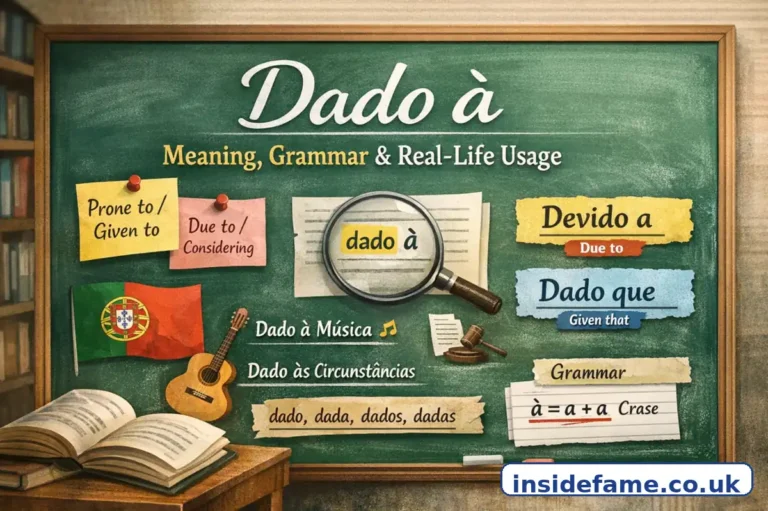
If you have seen Dado à in Portuguese and paused for a second, you are not alone. It is one of those expressions that looks simple on the surface but becomes more interesting the closer you study it. In some contexts, it points to cause, much like “given,” “considering,” or “due to.” In other contexts, it describes a person’s inclination, as in being “given to,” “prone to,” or naturally drawn toward something. Portuguese dictionaries recognize both functions: dado can work as a form tied to inclination, and it can also act as a prepositional marker of cause.
That dual role is exactly why this phrase creates confusion for learners, translators, and even careful writers. You are not just learning one expression here. You are learning how Portuguese handles meaning through grammar, agreement, and context. Once you understand that, Dado à stops looking tricky and starts looking useful.
What Dado à really means
At its core, Dado à grows out of dado, the past participle of dar, but dictionaries show that it no longer behaves only like a literal “given.” In one dictionary sense, dado means a person has a vocation or inclination toward something, with the example o rapaz é dado à música. Cambridge likewise glosses dado a / dado à figuratively as “given,” “accustomed,” or “addicted,” including the example um homem dado à bebida.
That is the first meaning many learners meet: someone is dado à leitura, dado à música, or dado à conversa. In natural English, that often becomes “fond of,” “prone to,” “inclined to,” or “given to.” It describes a pattern, not a one-time event. The phrase suggests repetition, disposition, or a recognizable trait.
The second meaning: cause, condition, and context
The phrase also belongs to a more formal causal family. Priberam defines dado as a preposition that can indicate cause, and the Academy of Sciences of Lisbon dictionary says the same, giving examples where dado introduces the reason or motive for something. That makes it close to “given,” “considering,” “in view of,” or “due to,” depending on the sentence.
This is where many articles online oversimplify the issue. The strongest way to understand Dado à is not to memorize one English translation, but to see that Portuguese lets the phrase point either toward disposition or cause. Context decides which reading is active. If the sentence talks about a person’s habits, the phrase usually signals tendency. If it sets up a reason for a decision, event, or outcome, it functions more like a causal opener.
Why the accent matters
A big part of the confusion comes from the accent in à. In Portuguese, à marks crase, the contraction of the preposition a with the feminine singular article a. That is why the spelling matters. It is not decoration. It signals structure. When the noun that follows is feminine singular and calls for that contraction, à is correct. When the noun is masculine singular, the form shifts to ao.
This one detail instantly explains a lot of learner mistakes. If you write dado à problema, the phrase sounds wrong because problema does not take feminine singular à in that position. If the noun is masculine, the expected structure moves toward ao. That is why understanding the noun after the phrase is one of the fastest ways to get the spelling right.
Agreement: dado, dada, dados, dadas
Another reason Dado à can feel unstable is that the word dado may agree in gender and number with the subject or with the broader structure of the sentence, depending on use. The common forms learners need to recognize are dado, dada, dados, and dadas, alongside a, à, ao, aos, às depending on what follows. Dictionary and grammar-oriented sources consistently show this agreement pattern as a key rule.
In practical terms, that means you may see Ela é dada à leitura, Ele é dado ao risco, Eles são dados a discussões, or Dadas as circunstâncias in more formal prose. You do not need to memorize every possible variant on day one. You just need to understand the logic: Portuguese is matching form to grammar, not randomly changing the phrase.
How Dado à works in real-life sentences
The easiest way to internalize the phrase is through sentence behavior. In trait-based usage, Dado à usually sits near a linking verb and introduces something habitual, characteristic, or revealing. A phrase like Ele é dado à bebida does not describe a single drink. It describes a known tendency. That exact figurative sense is reflected in Cambridge’s example “a man given to drinking.”
In explanatory writing, the phrase can set up a reason. A causal use of dado is recognized by major dictionaries as a way to indicate motive or cause, similar to “considering” or “given that condition.”
In both cases, the phrase adds a feeling of structure. It makes the sentence sound more considered, more deliberate, and often more formal than a plain everyday alternative.
Dado à in everyday English
For a U.S. English-speaking audience, the biggest translation mistake is trying to force one fixed equivalent. Dado à does not always equal the same English phrase. Sometimes “given to” is best. Sometimes “prone to” fits better. Sometimes “inclined toward” sounds more natural. And in causal contexts, “given,” “considering,” or “due to” may work better than any trait-based translation.
That flexibility matters if you are writing for readers, not just passing a grammar test. A translator, teacher, or language learner gets better results by asking, “What is the sentence doing?” rather than “What is the one correct English equivalent?” That mindset leads to cleaner, more native-sounding translation choices.
Dado à vs dado ao
This is one of the most common search questions around the phrase, and it deserves a direct answer. The difference between dado à and dado ao is mostly grammatical, not conceptual. The shift happens because Portuguese changes the article according to the noun that follows. With a feminine singular noun, you commonly get à. With a masculine singular noun, you commonly get ao.
So the meaning may stay very close while the grammar changes. A reader who knows that rule instantly understands why dado à música and dado ao risco do not compete with each other. They simply follow different noun patterns. That is one of the reasons a phrase that looks irregular at first becomes more predictable once you see the system behind it.
Dado à vs devido a, por causa de, and dado que
Portuguese offers several ways to express cause, but they are not identical in tone. The Academy dictionary and Priberam both place dado in the area of causal expression, and sources discussing usage commonly compare it with devido a and dado que. Priberam explicitly lists dado que as a causal expression introducing a subordinate clause.
Here is the practical difference. Por causa de often feels more everyday and conversational. Devido a is widely used and clear. Dado que works well when a full clause follows. Dado à or related given-forms can sound more shaped, more formal, and more tightly tied to a noun phrase. Writers often choose it when they want their sentence to feel measured rather than casual.
Common mistakes learners make
Most errors fall into three categories. First, learners overuse the accent and write à where the grammar does not support it. Second, they forget agreement and leave the form frozen even when the surrounding sentence clearly calls for another variant. Third, they confuse the idiomatic expression with the literal participle of dar, which leads to awkward translations. The dictionary evidence makes clear that the phrase has idiomatic value beyond the literal verb.
Another subtle mistake is using the expression for isolated actions. A sentence built around dado à usually works better when there is a sense of pattern, disposition, or structured explanation. If the action happened only once, the phrase can feel overstated. That is why real fluency here is less about memorizing a rule and more about recognizing the kind of sentence you are building.
How to use Dado à naturally in writing
A reliable way to write the phrase well is to choose from two tracks. In the first track, ask whether you are describing a habit, taste, tendency, or recognizable trait. If yes, Dado à may be a strong fit. In the second track, ask whether you are introducing the reason for a decision, change, or outcome. If yes, the causal reading may fit better. Both uses are supported in authoritative lexicographic sources.
Writers who sound natural with this phrase also tend to keep the sentence lean. They do not bury it in heavy wording. They let the expression do one clear job, then move on. That is especially useful in academic prose, translation work, and polished explanatory writing, where clarity matters more than ornament.
Why the phrase matters in formal Portuguese
One reason Dado à keeps appearing in searches is that it carries more than dictionary meaning. It carries register. A phrase like this can subtly raise the level of the sentence. In formal writing, that can be an advantage. It helps present reasoning with control and present description with precision. The Academy dictionary’s treatment of dado as a causal form and Priberam’s treatment of dado que support that broader formal function.
That does not mean the phrase is only for legal writing or advanced literature. It means the phrase is useful whenever you want a sentence to sound purposeful. For learners, that is a valuable distinction. You are not only learning what the words mean. You are learning when the phrase sounds stronger than the alternatives.
A simple memory trick
If you want a practical shortcut, remember this: when Dado à points to a person’s pattern, think “given to.” When it introduces a reason or condition, think “given” or “considering.” Then check the noun that follows. If it is feminine singular, à may be exactly what the sentence needs. If not, another form is probably better. That rule of thumb lines up with the dictionary-backed grammar and keeps you from chasing overly complicated explanations.
The more examples you read, the more natural this becomes. Portuguese learners often improve fastest when they stop treating Dado à as a puzzle and start treating it as a sentence pattern with two core jobs. Once you see those two jobs clearly, the phrase becomes much easier to recognize and use.
Final thoughts
Dado à is one of those Portuguese expressions that rewards close attention. It can describe an inclination, habit, or tendency, and it can also introduce cause, motive, or condition depending on context. Major dictionary sources support both sides of that picture: the tendency meaning appears in Priberam and Cambridge, while the causal function appears in Priberam and the Academy of Sciences of Lisbon dictionary.
That is the real key to mastering the phrase. Do not look for a single English equivalent and do not reduce it to one grammar rule. Instead, learn how it behaves. Watch the noun that follows, notice whether the sentence is describing character or explaining cause, and let context guide the translation. When you do that, Dado à stops being confusing and starts becoming one of the most useful precision tools in your Portuguese vocabulary.
Frequently Asked Questions (FAQs)
What does Dado à mean in Portuguese?
It usually means either “given to,” “prone to,” or “inclined to” when describing a tendency. In other contexts, related uses of dado can signal cause, similar to “given,” “considering,” or “due to.”
Is Dado à always used for personality traits?
No. It is often used for habits, tendencies, or recurring characteristics, but related forms of dado can also introduce cause or condition in more formal writing. Context is what decides the function.
What is the difference between dado à and dado ao?
The difference is grammatical. Dado à usually appears with a feminine singular noun, while dado ao appears with a masculine singular noun.
Why does Dado à have an accent?
The accent in à marks crase, the contraction of the preposition a with the feminine article a. It is a grammar signal, not just a spelling detail.
Can Dado à mean “due to”?
Yes, in causal or formal explanatory contexts, related dado constructions can indicate cause or motive. Authoritative Portuguese dictionaries explicitly record that function.
Is Dado à formal or informal?
It tends to sound more careful and structured than very casual alternatives. That is one reason it shows up in polished writing, translation, and explanatory prose.
Can I translate Dado à as “given to” every time?
No. “Given to” works well for tendency, but in causal contexts, “given,” “considering,” or “due to” may be more natural. The sentence function matters more than a one-size-fits-all translation.
Is Dado à the same as devido a?
Not exactly. They can overlap in causal meaning, but they are not identical in tone or structure. Dado and dado que often sound more formal or more tightly structured in context.
Can Dado à be used in everyday speech?
Yes, people can understand it in speech, especially in tendency-based uses. Still, some alternatives may sound more casual depending on the setting.
What is the biggest mistake learners make with Dado à?
The most common mistakes are misusing the accent, ignoring agreement, and assuming the phrase has only one meaning. Most problems disappear once you check the noun and the sentence purpose.
Does Dado à change in plural?
Yes. Portuguese agreement can produce plural forms such as dados and dadas, along with article changes like aos and às depending on grammar.
What is the best way to learn Dado à fast?
Learn it through real sentence patterns. Focus on the two main jobs it performs: describing tendency and introducing reason. That approach is more effective than memorizing isolated translations.
FOR MORE : INSIDE FAME
