


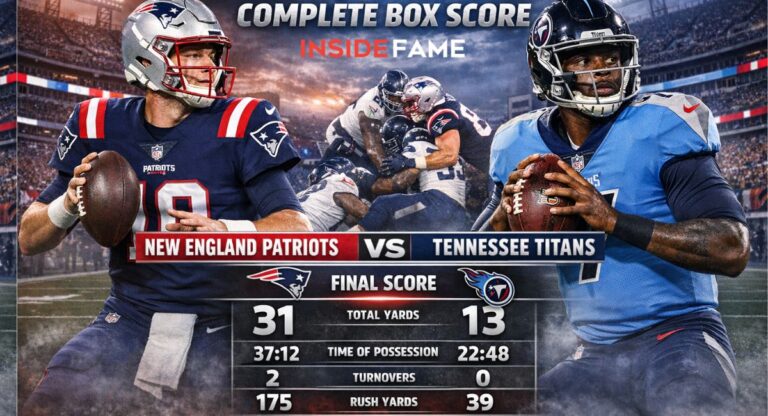
When fans look back on the 2025 season, this trip to Nashville will stand out as the night New England’s new-look offense and opportunistic defense put everything together. The matchup between the Patriots and Titans ended 31–13 in favor of New England, but the real story lives inside the numbers. The New England Patriots vs Tennessee Titans Match Player Stats reveal how Drake Maye’s accuracy, Rhamondre Stevenson’s power running and a swarming defense turned an early deficit into a comfortable road win. From completion percentages to time of possession, every major stat category points to why this game felt so one-sided after halftime.
Game context and stakes
This was more than just another Week 7 game. New England arrived at Nissan Stadium riding a three-game road win streak and chasing the top spot in the AFC East, while Tennessee was trying to stabilize under interim head coach Mike McCoy after a rough start and a coaching change. It also marked the emotional return of Mike Vrabel to the city where he had once been the Titans’ head coach, now leading the Patriots into a stadium full of familiar faces. For New England, the night became a statement that the post-Brady era might finally have a long-term answer at quarterback. For Tennessee, it underscored how far the roster still has to go against more complete contenders.
Shorter Quick-Overview Box with just the Core Stats:
| Team | Score | Total Yards | Turnovers | Time of Possession |
|---|---|---|---|---|
| New England Patriots | 31 | 387 | 0 | 37:12 |
| Tennessee Titans | 13 | 255 | 2 | 22:48 |
Drake Maye’s precision passing night
Drake Maye’s box score jumps off the page even before you get to the historical context. He completed 21 of 23 passes for 222 yards and two touchdowns, finishing with a passer rating well over 130 and at one point stringing together 16 completions in a row. Across multiple outlets, the final numbers settle at 91-plus percent completion, enough to break Tom Brady’s long-standing franchise record for single-game accuracy.
The distribution of those throws shows how patient and balanced the plan was. Stefon Diggs led the team with seven catches for 69 yards, consistently working underneath zones to keep the chains moving. Boutte made the game’s splash play on his 39-yard score, while Mack Hollins added 49 yards on just two receptions, stretching the field on deep crossers. Hunter Henry and Demario Douglas provided reliable intermediate targets, combining for seven grabs and several key first downs. Maye rarely forced the ball into danger, took what the coverage allowed and punished late rotations with quick throws to his backs and tight ends.
Patriots’ ground game and offensive balance
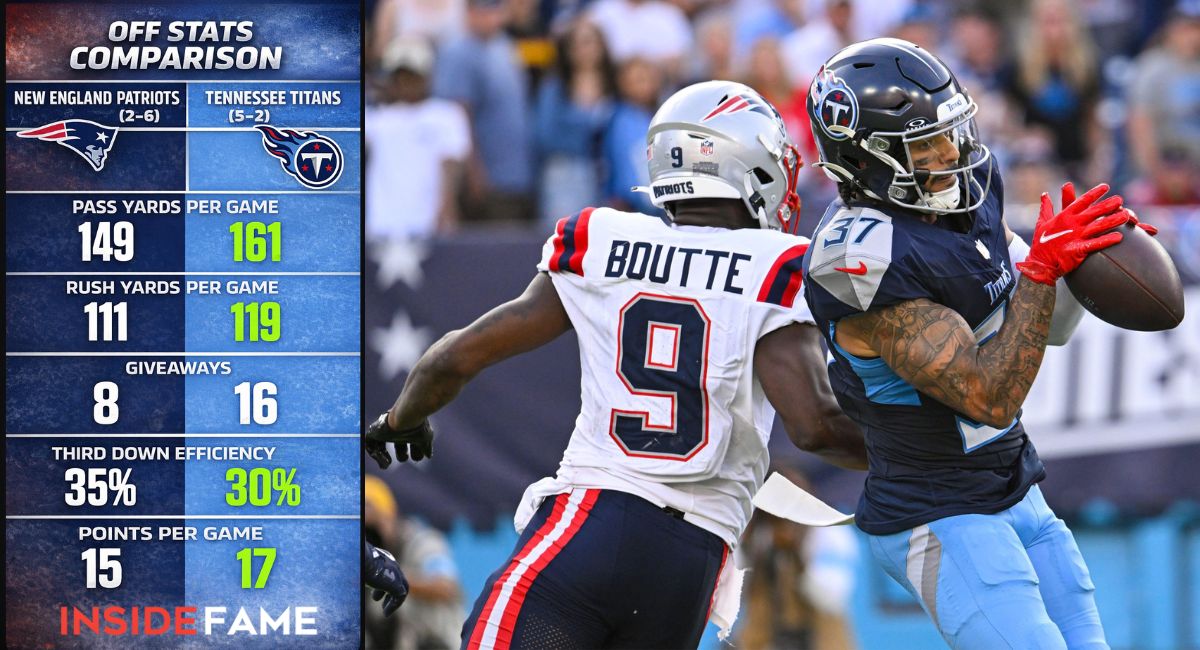
A look at the rushing column makes it obvious why Tennessee’s defense spent so much time on the field. New England piled up 175 rushing yards on 36 attempts, an efficient 4.9 yards per carry. Stevenson set the tone with 18 carries for 88 yards and a touchdown, finishing runs through contact and constantly falling forward. Maye contributed another 62 yards on scrambles and designed keepers, turning what could have been sacks into positive gains.
The Patriots did not rely on one long run to inflate their totals; instead, they strung together steady gains that turned second-and-long situations into manageable downs. Backup runners Ty Montgomery and others chipped in just enough to keep Stevenson fresh. The offensive line, often questioned in previous seasons, controlled the line of scrimmage for long stretches, especially in the third quarter when the Titans’ front seven started to tire and arm tackles bounced off New England rushers.
Titans’ aerial attack and young playmakers
For Tennessee, the passing numbers tell a more complicated story. Cam Ward finished 25 of 34 for 255 yards with one touchdown and one interception, solid on paper but hurt by two back-breaking turnovers. When he had time, he looked sharp, especially on deep shots and intermediate digs. Dike was the featured weapon, catching four passes for 70 yards and the Titans’ lone touchdown. Fellow young targets like Gunnar Helm, Elic Ayomanor, Tyjae Spears and Tyler Lockett all contributed, combining for double-digit receptions and several chunk plays.
Yet the box score also shows the hidden cost of protection issues. Ward took five sacks for 39 lost yards, often under heavy pressure up the middle. On the fumble that Chaisson returned for a touchdown, the pocket collapsed almost immediately, forcing Ward to hold the ball a split second too long. His late interception on a deep over route ended one of Tennessee’s few promising second-half drives and symbolized a night when the Titans’ passing game flashed potential but lacked the mistake-free execution needed to keep pace.
Situational football and hidden stats
Beyond basic yards and points, situational stats show how completely New England controlled the details. The Patriots converted 5 of 12 third downs and went a perfect 2 for 2 on fourth-down attempts, while Tennessee managed only 3 of 10 on third down and failed on both fourth-down tries. New England also cashed in two of three red-zone trips, whereas Tennessee never managed a red-zone appearance after halftime.
Time of possession tells the same story. The Patriots held the ball for 37 minutes and 12 seconds compared with just 22:48 for the Titans, a nearly fifteen-minute gap that reflects New England’s ability to sustain drives and Tennessee’s rapid three-and-outs. With more plays (64 to 51) and more first downs (22 to 16), New England simply had more chances to wear down the Titans defense and protect their own defenders with long, methodical drives.
All 7-Match History Table:
| Date | Winner | Score (Patriots–Titans) | Stadium | City & State | Game Type |
|---|---|---|---|---|---|
| Oct 19, 2025 | Patriots | 31 – 13 | Nissan Stadium | Nashville, Tennessee | Regular season |
| Nov 3, 2024 | Titans | 17 – 20 (OT) | Nissan Stadium | Nashville, Tennessee | Regular season |
| Nov 28, 2021 | Patriots | 36 – 13 | Gillette Stadium | Foxborough, Massachusetts | Regular season |
| Jan 4, 2020 | Titans | 13 – 20 | Gillette Stadium | Foxborough, Massachusetts | AFC Wild Card |
| Nov 11, 2018 | Titans | 10 – 34 | Nissan Stadium | Nashville, Tennessee | Regular season |
| Jan 13, 2018 | Patriots | 35 – 14 | Gillette Stadium | Foxborough, Massachusetts | AFC Divisional |
| Dec 20, 2015 | Patriots | 33 – 16 | Gillette Stadium | Foxborough, Massachusetts | Regular season |
Defensive impact and turning points
On the defensive side, New England’s box score is less about individual gaudy numbers and more about collective disruption. The Patriots recorded four sacks, repeatedly collapsing the pocket and forcing Ward off his spot. Linebacker Marte Mapu led the team in tackles, while Christian Gonzalez and other young defenders provided tight coverage that limited yards after the catch.
The two turnovers were the game’s true turning points. Midway through the third quarter, Chaisson’s scoop-and-score not only added seven points but also deflated the Titans sideline. Later, a well-timed zone look baited Ward into throwing his interception, which New England converted into another long, clock-draining drive. Tennessee’s defense, meanwhile, could not generate a single takeaway and allowed a defensive touchdown, turning a relatively even yardage battle in the air into a lopsided final margin.
Coaching narratives and emotional angles
From a narrative standpoint, this game will always be tied to Vrabel’s return to Tennessee. The former Titans coach, now in charge of the Patriots, faced the franchise that let him go amid a rebuild. Reports from both national and local outlets noted how focused he was on treating this as “just another game,” yet the post-game hugs and locker-room reaction made clear how much the win meant.
On the opposite sideline, McCoy was trying to hold together a roster that had already cycled through changes and injuries. Tennessee’s early scripted success reflected a well-prepared opening plan, but once New England adjusted, the Titans struggled to find counters. The contrast between a stable, ascending program and a rebuilding one showed up in late-game discipline, situational decisions and the confidence with which each team handled key downs.
Reading the box score: what matters most
For fans scanning the numbers after the fact, a few elements stand out as the clearest summary of what happened on the field:
-
The passing efficiency gap, with Maye’s record-setting completion rate and clean stat line compared with Ward’s solid but turnover-affected outing.
-
The rushing imbalance, where New England more than quadrupled Tennessee’s ground yardage and controlled tempo.
-
The situational edge on third and fourth down, red-zone trips and time of possession, all tilted heavily toward the Patriots.
-
The turnover differential of 0–2, punctuated by a defensive touchdown, which turned a competitive first half into a runaway.
Those four pillars—passing precision, ground dominance, situational execution and turnover margin—explain why the final score looks like a blowout even though the Titans actually outgained the Patriots slightly through the air.
What the result means for New England
From New England’s perspective, this game reinforced the idea that the offense can win games in different ways. Maye has now delivered multiple outings with 200-plus passing yards and a rating above 100, joining rare company among young quarterbacks. His connection with Diggs, Boutte and Henry is growing more natural each week, and Stevenson’s resurgence behind an improving line gives the Patriots a reliable foundation when winter weather hits later in the season.
The win pushed the Patriots to 5–2 and kept them atop a competitive AFC East race, according to updated standings. Just as important, it capped a perfect three-game road swing, something the franchise had never done in the regular season since the AFL-NFL merger. For a fan base searching for signs that life after Brady can still include deep playoff runs, this blend of explosive plays, balance and toughness was exactly what they hoped to see.
What the result means for Tennessee
For Tennessee, the 1–6 record after this loss paints a harsh picture, but the box score offers hints of hope. Ward’s 255 passing yards, along with the emergence of Dike, Helm and Ayomanor, suggest that the Titans may have finally found a young core at quarterback and receiver. Spears’ quickness out of the backfield and Pollard’s versatility remain useful tools if the offensive line can stabilize.
At the same time, the numbers highlight what must change. The inability to run the ball, protect Ward or create takeaways on defense turned their early lead into a distant memory. The injury to star lineman Jeffery Simmons only adds to the challenge, leaving the Titans in evaluation mode for the rest of the season as they focus on development and roster building rather than immediate contention.
Atmosphere at Nissan Stadium
Beyond the numbers, this game carried the feel of a big occasion. A crowd of more than 67,000 filled Nissan Stadium, with CBS carrying the broadcast to a national audience. Early on, the home fans roared as the Titans jumped ahead and the defense forced New England into third-and-long situations. As the night wore on and the Patriots stacked scoring drives, the noise shifted; traveling New England supporters grew louder while local fans watched another potential upset slip away.
For neutral viewers, the contrast between Maye’s composed precision and Ward’s high-variance style made the game compelling even after the score widened. The defensive touchdown, record-breaking completion rate and emotional post-game scenes between Vrabel and his former players created the kind of layered story that goes far beyond a typical mid-season contest.
Final thoughts
Taken as a whole, the New England Patriots vs Tennessee Titans Match Player Stats offer a clear explanation of why the scoreboard looked the way it did. New England paired elite passing efficiency with a bruising ground game, sharp situational decisions and a defense that tightened as the night went on. Tennessee showed flashes of promise through its young receiving corps and quarterback but could not overcome protection problems, turnover swings and a vanishing run game.
For Patriots fans, this box score feels like a possible preview of a new era built around Maye’s arm and Vrabel’s physical identity. For Titans supporters, it serves as both a reality check and a roadmap, highlighting where the roster has genuine talent and where upgrades are essential. Either way, the game provides a rich statistical snapshot that rewards anyone who looks beyond the headline score and dives into the details behind it.
Frequently Asked Questions (FAQs)
How did Drake Maye perform in this game?
He completed 21 of 23 passes for 222 yards and two touchdowns, one of the most accurate outings in team history. His calm decisions and quick reads kept the offense on schedule.
Why was New England’s offense so hard to stop?
They mixed short, high-percentage throws with a strong ground game, so Tennessee never knew what was coming. That balance helped them dominate key downs and control the clock.
Who were the Patriots’ top playmakers on offense?
Rhamondre Stevenson led the rushing attack with 88 yards and a score, while Stefon Diggs, Kayshon Boutte and Mack Hollins provided the biggest gains through the air. Together they gave Maye options at every level.
How did the Titans move the ball through the air?
Cam Ward threw for 255 yards with one touchdown, leaning on Chimere Dike, Van Jefferson, Tony Pollard and Gunnar Helm. They found early success with quick passes before pressure and coverage adjustments slowed them down.
What went wrong with Tennessee’s rushing attack?
The Titans finished with only 39 rushing yards on 12 carries and rarely created clean lanes. Once they fell behind by two scores, they were forced to abandon the run and became predictable.
How important was time of possession in this matchup?
New England held the ball for almost fifteen minutes longer than Tennessee, which kept their defense fresh and wore down the Titans’ front. That edge came from sustained, mistake-free drives.
Which defensive play changed the game the most?
The scoop-and-score fumble return by K’Lavon Chaisson in the third quarter was the turning point. It stretched the lead to 31–13 and took the crowd out of the game.
How did New England’s defense adjust after the slow start?
They tightened coverage on early downs, communicated better in the middle of the field and increased pressure on Ward. Those changes produced more sacks, a fumble and a late interception.
What did this win show about the Patriots’ season outlook?
It showed they can win on the road with balance and discipline, pushing their record to 5–2 and reinforcing their status as a serious conference contender. The performance fit a growing pattern of steady improvement.
What did this loss reveal about the Titans’ current state?
It highlighted their reliance on the passing game, issues in pass protection and trouble creating takeaways on defense. At 1–6, they look more like a team building for the future than chasing the playoffs.
How did special teams factor into the result?
Both sides made their kicks, but New England’s ability to finish drives with touchdowns rather than field goals was the real difference. Tennessee’s early field goals could not keep pace once the Patriots’ offense caught fire.
What can fans learn by studying this box score?
They can see how rushing success, third-down efficiency, turnover margin and time of possession often matter more than total passing yards. This game is a clear example of how those hidden numbers decide the final score.
FOR MORE : INSIDE FAME
