


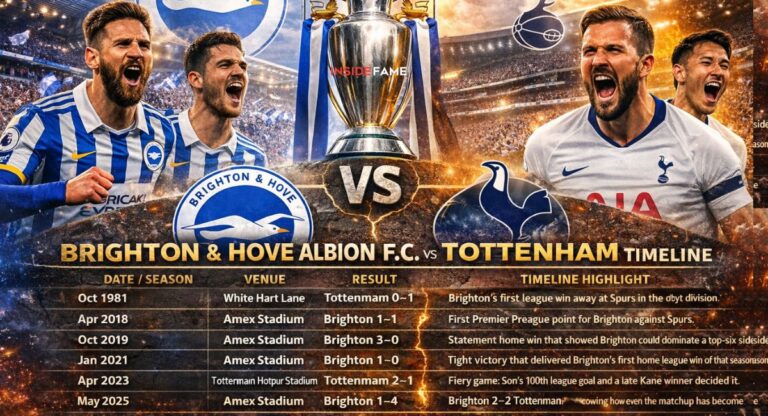
When Brighton & Hove Albion F.C. and Tottenham Hotspur meet today, the game feels like a natural part of the Premier League schedule, but the history between the clubs is much older and less straightforward than it looks. Tottenham are long-time members of England’s elite, used to chasing trophies and European qualification, while Brighton have climbed from financial crisis and lower-league battles to a secure place in the top flight. Lining up the Brighton & Hove Albion F.C. vs Tottenham timeline in order turns scattered memories into a single story, showing how a regional pairing slowly evolved into a modern fixture full of tactical interest, emotional swings and worldwide attention.
For supporters in the United Kingdom this matchup carries local pride, while fans in the United States and other countries often discover both clubs through these televised meetings and learn their backstories at the same time. Because the games rarely feel predictable, they are a convenient entry point for new followers of English football who want drama without needing decades of background knowledge. The timeline between Brighton & Hove Albion F.C. and Tottenham Hotspur therefore works as both a historical record and a quick guide to how each club has changed over time.
Overall Head-to-Head Snapshot
| Aspect | Detail |
|---|---|
| Total competitive meetings | 32+ matches in all competitions |
| Tottenham wins | 18 wins (overall advantage) |
| Brighton wins | 9 wins |
| Draws | 5 draws |
| Goals | Tottenham 48+ – Brighton 37+ |
| First meetings | Early 1900s, Southern League era |
| First top-flight clash | Late 1970s in the old First Division |
| Modern era start | 2017–18 season, when Brighton joined the Premier League |
| Most recent result | 2–2 draw at the Amex in September 2025 |
| Overall pattern | Tottenham lead historically, but results are much closer in recent seasons |
Early chapters and First Division meetings
The earliest chapters belong to the early 1900s, when both clubs played in the Southern League rather than a national top division. Brighton were a young professional side representing a growing seaside town, while Tottenham, already FA Cup winners, carried themselves like future giants. Matches were physical and often scrappy, decided by set pieces or mistakes in crowded penalty areas.
The next meaningful cluster of games arrived when Brighton earned promotion to the old First Division at the end of the 1970s. Suddenly the teams saw each other regularly in the top tier, and fans on both sides began to recognise the journey to the other’s ground. Between 1979 and 1983 they won two of eight league meetings, including a celebrated 1–0 success at White Hart Lane in October 1981, when Michael Robinson’s winning goal gave the visitors a rare away triumph and a permanent place in club folklore. For many Brighton supporters of that generation, that victory is the defining early waypoint in the timeline.
Separation years and cup encounters
After Brighton’s relegation from the top flight, the stories of the two clubs diverged sharply. Tottenham became part of the newly formed Premier League, while Brighton slid down the divisions, lost their historic Goldstone Ground and spent years simply trying to survive. For a long period the Brighton & Hove Albion F.C. vs Tottenham timeline records only occasional domestic cup ties. Spurs edged a narrow FA Cup meeting in 2005 and later recorded a routine League Cup win in 2014, fixtures that mainly underlined the distance between the sides.
For Brighton supporters who packed into away ends on those days, though, the matches meant more than just elimination. They were reminders of the level they still hoped to reach again, glimpses of packed Premier League stadiums and high-profile opponents. Those evenings kept Tottenham in Brighton’s consciousness at a time when the clubs otherwise had little reason to cross paths.
Promotion and the modern Premier League series

That ambition finally became reality in 2017, when Brighton’s long rebuild delivered promotion to the Premier League and turned the pairing into a guaranteed home-and-away contest every season. Tottenham claimed early control of the modern series, winning 2–0 at home in December 2017 and generally dominating the ball in the first few meetings. Brighton, managed by Chris Hughton, responded with disciplined defending, quick breaks and a heavy emphasis on set pieces. In April 2018 they earned a valuable 1–1 draw at the Amex thanks to a Glenn Murray penalty, a result that pushed them closer to safety and showed they could frustrate more glamorous visitors with careful organisation rather than simply clinging on.
By the 2018–19 season the rivalry already felt different. Tottenham still relied on the creativity of Christian Eriksen and the ruthless finishing of Harry Kane, but Brighton no longer treated the fixture as a free hit. In April 2019, Spurs needed a late long-range strike from Eriksen at their temporary Wembley home to scrape a 1–0 win, a match that captured how small the margins had become between patient defending and an impressive upset.
Brighton’s breakthrough league victories
The timeline took a dramatic turn in October 2019. On a bright afternoon at the Amex, Brighton pressed aggressively, attacked down the flanks and punished a fragile visiting defence to earn a stunning 3–0 win. Teenage forward Aaron Connolly scored twice, Neal Maupay added another, and Tottenham’s captain and goalkeeper Hugo Lloris suffered a serious early injury that seemed to sum up a chaotic spell for the north London club. For Brighton, this was far more than three points: it was proof that they could dominate a team with Champions League ambitions over ninety minutes.
That result did more than shift a single season. It signalled that Brighton could dictate terms rather than simply reacting. The feeling grew stronger in January 2021, when Leandro Trossard finished off a sharp move to secure a 1–0 home win and Brighton’s first league victory at the Amex that season. Spurs, then coached by a pragmatic manager, struggled to build sustained attacking pressure, while Brighton looked composed on the ball and confident in their structure.
Defining wins for Tottenham
On Boxing Day 2019 they came from behind at home to beat Brighton 2–1, adjusting their approach at halftime and using Kane’s movement to unlock a tiring defence. The most striking example arrived in April 2023, when the teams met in north London for an intense, controversy-filled match that featured touchline clashes and several long video checks. Heung-min Son opened the scoring with a brilliant curling finish from the edge of the area, his 100th Premier League goal, before Lewis Dunk equalised from a corner. Harry Kane then scored a late winner to seal a 2–1 success that felt hugely important in Tottenham’s push for a top-four place and underlined the individual quality that still sets them apart.
These matches reminded everyone that Tottenham still possess the kind of elite attackers who can decide a game with a moment of brilliance. Even in periods when the team has looked disjointed, the presence of forwards like Kane and Son has kept their overall record against Brighton strong.
High-scoring thrillers in recent seasons

Recent seasons have added a run of high-scoring thrillers that show how adventurous both sides have become. In December 2023 Brighton stormed into a four-goal lead at home through two João Pedro penalties, a composed finish from Jack Hinshelwood and a spectacular long-range strike from Pervis Estupiñán, before Spurs rallied late to make the final score 4–2. The drama continued in 2024–25, when Brighton ended the league campaign with a remarkable 4–1 victory away in north London, and into 2025–26, when Tottenham came from two goals down to draw 2–2 at the Amex thanks to a late surge.
Some of the key modern waypoints that define this phase of the Brighton & Hove Albion F.C. vs Tottenham timeline include:
Key Matches on the Timeline
| Date / Season | Venue | Result | Timeline highlight |
|---|---|---|---|
| Oct 1981 | White Hart Lane | Tottenham 0–1 Brighton | Brighton’s first league win away at Spurs in the top division. |
| Apr 2018 | Amex Stadium | Brighton 1–1 Tottenham | First Premier League point for Brighton against Spurs, vital in the survival push. |
| Oct 2019 | Amex Stadium | Brighton 3–0 Tottenham | Statement home win that showed Brighton could dominate a top-six side. |
| Jan 2021 | Amex Stadium | Brighton 1–0 Tottenham | Tight victory that delivered Brighton’s first home league win of that season. |
| Apr 2023 | Tottenham Hotspur Stadium | Tottenham 2–1 Brighton | Fiery game; Son’s 100th league goal and a late Kane winner decided it. |
| Dec 2023 | Amex Stadium | Brighton 4–2 Tottenham | High-tempo thriller with Brighton racing into a four-goal lead before a late Spurs fightback. |
| May 2025 | Tottenham Hotspur Stadium | Tottenham 1–4 Brighton | Heavy away win that underlined how far Brighton had come in the Premier League. |
| Sept 2025 | Amex Stadium | Brighton 2–2 Tottenham | End-to-end draw with Brighton’s fast start and Tottenham’s late recovery showing how even the matchup has become. |
Overall record and balance of power
Across the entire Brighton & Hove Albion F.C. vs Tottenham timeline in order, the numbers still favour the London club. Data gathered from several statistical databases shows Spurs holding roughly twice as many wins as Brighton in competitive meetings, along with a clear advantage in goals scored, reflecting their longer stay in the top division and their ability to attract high-profile signings over many decades.
Those same figures also reveal a shrinking gap when only recent seasons are considered. Brighton now own multiple league victories both home and away, plus heavy wins and dramatic draws that have chipped away at any sense of inevitability. Form, injuries, fixture congestion and tactical choices matter far more today than simple reputation.
Players who shaped the rivalry
Individual players give the timeline its human focus. For Tottenham, Kane and Son dominate recent chapters, providing long-range strikes, composed finishes from inside the box and clever movement that repeatedly changes matches against Brighton. Central defenders such as Jan Vertonghen, Toby Alderweireld and Cristian Romero have contributed crucial clearances and set-piece goals, while creative midfielders have stitched moves together with disguised passes and accurate delivery from corners and free-kicks.
On Brighton’s side of the story, figures like Glenn Murray, Pascal Groß and Lewis Dunk represent the backbone of the club’s modern rise. Murray’s penalty in the 2018 draw was essential in the survival race, Groß has repeatedly controlled the rhythm of games from midfield and Dunk has been ever-present at the back, producing last-ditch blocks, towering headers and calm distribution under pressure. In the newer chapters, players such as Leandro Trossard, Kaoru Mitoma, João Pedro and Jack Hinshelwood have supplied the flair, bringing dribbling, late runs and precise finishing that transform solid tactical plans into memorable results.
Supporters, stadiums and atmosphere
Supporters and stadiums provide the emotional backdrop that ties all of these events together. At the Amex Stadium, built into the Sussex landscape, the crowd sits close to the pitch and can generate intense noise when Brighton press high or chase a late equaliser. Night matches there often feel especially charged, with long journeys home for travelling fans adding to the sense of occasion. For many Brighton supporters, famous results against Spurs are tied in memory not just to goals but to songs, flags and the sight of a packed south-coast ground celebrating together.
When Tottenham attack relentlessly and score early, the noise can feel overwhelming for opponents; when Brighton play bravely and take the lead, a nervous hush sometimes spreads instead. Late goals at either venue—whether a Brighton counterattack, a Son curler or a scrambled finish from a set piece—instantly become new waypoints on the shared timeline, remembered for seasons to come and replayed in highlight reels and conversations.
What the timeline reveals and future chapters
Put together, these episodes reveal how much the relationship between the clubs has changed. Early meetings framed Brighton as outsiders testing themselves against a glamour opponent; modern results show a confident, well-run south-coast side capable of outplaying Tottenham on their day, even in north London. The Brighton & Hove Albion F.C. vs Tottenham timeline in order therefore reads less like a story of permanent dominance and more like an evolving contest between two ambitious clubs on different, but occasionally intersecting, paths.
Future chapters will likely feature more tactical twists, new rising stars and perhaps even meetings in European competition if both projects continue on their current trajectories. Whether the next entry in the timeline is a late winner, a stunning comeback or a measured tactical masterclass, it will be followed closely by supporters and neutral viewers alike. Each fresh meeting between Brighton & Hove Albion F.C. and Tottenham Hotspur has the potential to reshape how the rivalry is viewed—and to make the connection between the south coast and north London one of the most intriguing subplots in the wider story of the modern game.
Frequently Asked Questions (FAQs)
How many times have Brighton and Tottenham met in competitive games?
Across all competitions, the clubs have faced each other more than forty times, with Tottenham holding the overall edge in wins and goals scored.
Which club has the better overall record in this fixture?
Tottenham have the stronger historical record, with roughly twice as many victories as Brighton, although the gap has narrowed significantly in recent seasons.
When did Brighton first win away at Tottenham in the league?
Brighton’s first league win away at Tottenham came in October 1981, a 1–0 success in the old First Division that remains a cherished memory for older supporters.
Why is the 3–0 Brighton win in 2019 considered a turning point?
The 3–0 victory at the Amex in October 2019 showed Brighton could dominate Spurs with aggressive pressing and confident attacking, rather than just defending deep and hoping for a break.
What made the 2021 1–0 win special for Brighton?
Leandro Trossard’s winner in January 2021 gave Brighton their first home league victory of that season and underlined how comfortable they had become against high-profile visitors.
What was significant about the April 2023 game at Tottenham?
The April 2023 match featured touchline clashes, several video reviews and a brilliant goal from Heung-min Son, whose strike brought up his 100th league goal before Harry Kane scored a late winner.
Why is the 4–2 match in December 2023 often mentioned?
Brighton’s 4–2 home win in December 2023 summed up the modern version of this fixture: brave passing from the back, relentless pressing and a game that stayed entertaining even as Spurs mounted a late comeback.
How did Brighton manage a 4–1 win away in 2025?
On the final day of the 2024–25 league season, Brighton punished defensive errors, finished their chances ruthlessly and ran out 4–1 winners in north London, even though Spurs had already secured major European success that year.
Are games between these two clubs usually high scoring?
Older meetings were often tight, but recent seasons have produced several high-scoring contests, including 4–2, 4–1 and 2–2 results that show how attack-minded both teams have become.
Which players have had the biggest impact on the rivalry?
Harry Kane and Heung-min Son have shaped many Tottenham wins, while Glenn Murray, Pascal Groß, Lewis Dunk, Leandro Trossard and newer names like Kaoru Mitoma and João Pedro have defined Brighton’s side of the story.
What tactical approaches does Brighton usually use against Spurs?
Brighton now tend to build from the back, use fluid midfield rotations and press high, trying to draw Spurs forward and then play through the spaces, although earlier versions of the team relied more on deep defending and counters.
What might future meetings between these clubs look like?
If both clubs continue on their current paths, future games are likely to remain fast, tactically complex and important in the race for European places, with either side capable of winning home or away on the day.
FOR MORE : INSIDE FAME
